Seven steps for testing AI in patient analytics
A framework for moving from fragmented patient data to tested analytics, controlled use and continuing review.


In part 1 of this series, we examined the data foundation for patient-centered analytics. In part 2, we explored ontology and data agents as ways to add business context and questions on demand. Two requirements carry through both discussions: data must reflect operational reality, and people need to understand how an AI-generated answer differs from a predefined report.
This final installment asks how an organization can judge whether its AI layer is ready to address the patient-related problem it was built to solve. I propose seven steps for moving from fragmented data toward a controlled analytics capability, with explicit testing and ongoing review.
- Measure fragmentation in the patient-centered data platform.
- Reduce fragmentation in the bronze and silver layers, starting with critical domains.
- Build AI prototypes around questions with known answers.
- Measure accuracy, consistency and the consequences of mistakes.
- Promote only tools that pass the tests appropriate to their intended use.
- Repeat testing and review as the tools and their context change.
- Expand domain by domain.
Step 1 Measure fragmentation
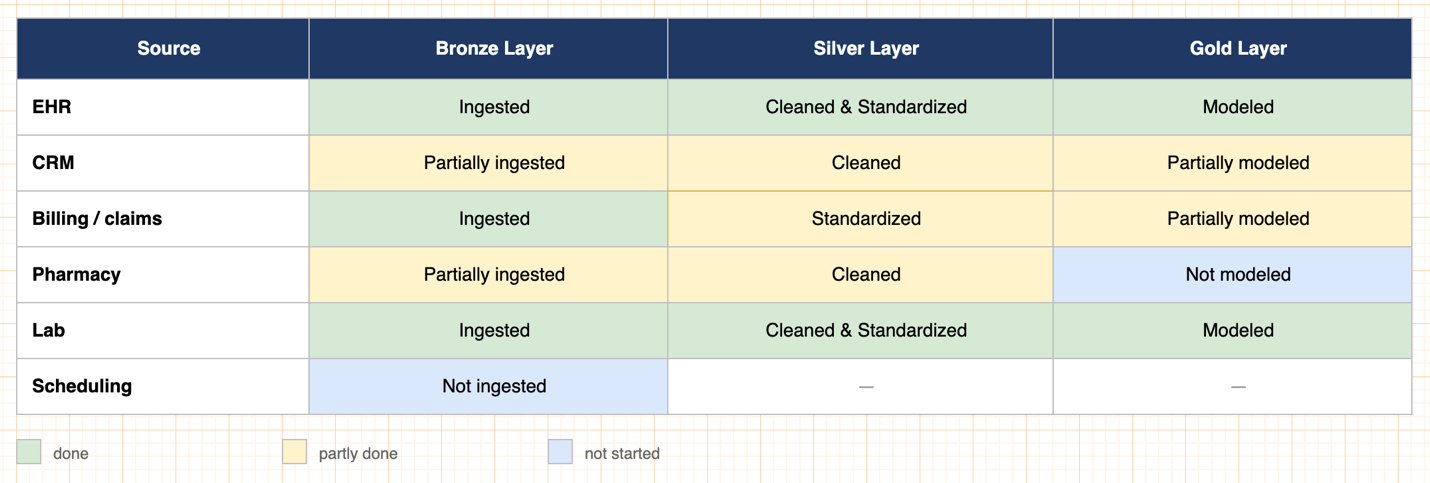
The first step is to understand where information is missing, incomplete or inconsistently prepared. A matrix of source systems against bronze, silver and gold layers gives a high-level view that can guide prioritization. It should describe the organization’s actual readiness rather than imply that every source needs to reach the same state at once.
Step 2 Start with critical domains
Reducing fragmentation requires an organized approach to how information is stored and prepared. The medallion architecture described in the first article provides one useful pattern. Bronze preserves source data, silver cleans and standardizes it, and gold supports business reporting and analysis.
If customer relationship management data are marked yellow across all three layers, ask how critical those data are to the intended use. That helps prioritize the domain when staff capacity is limited. Then ask what the organization needs from the data now and in a year. Those requirements help identify missing source information and shape the silver and gold models.
As yellow and blue areas are resolved, the platform becomes more complete for its chosen uses. Completion of a layer is still only one part of readiness. The organization also needs usable definitions, appropriate access and evidence that the data support the questions being asked.
Step 3 Prototype with known answers
Suppose the platform has the key bronze, silver and gold data needed for an outreach or marketing analysis. That domain may be a practical place to prototype an AI layer, provided the use and data access are authorized. Start with questions answered by existing reports.
Those reports already reflect business questions and can provide a comparison for validation. Reproducing their logic helps show whether the agent understands the organization’s measures, filters and terminology. A trusted report is useful evidence, although its definitions, data date and calculations also need to be checked before it becomes a test benchmark.
Step 4 Test accuracy and consistency
Build a small ontology or data-agent prototype on the relevant prepared data. For each tool, write a set of questions and variations in wording, obtain answers and compare them with the trusted reports. A mismatch should lead to investigation of the source data, definitions, instructions or generated query.
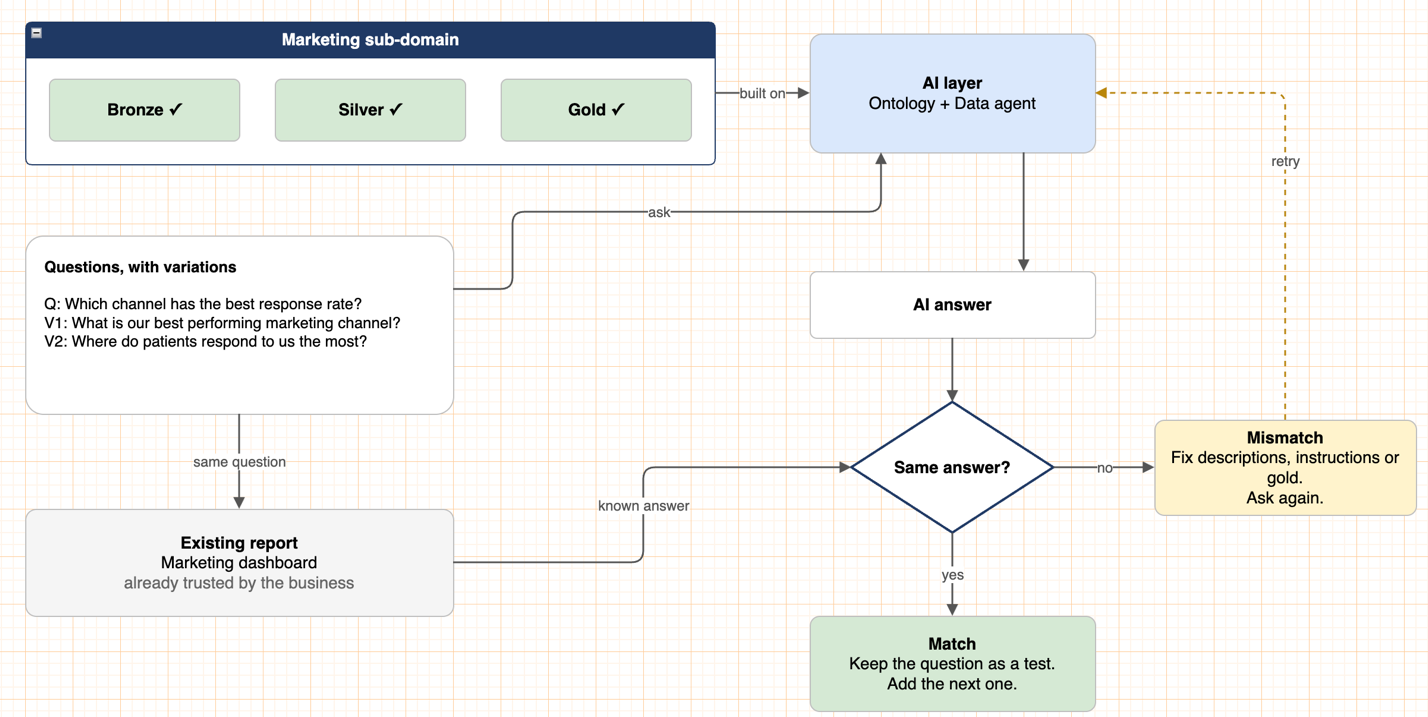
The goal is an improved ontology or data agent and a repeatable set of tests. Include questions that were not used to tune the tool, as well as ambiguous requests and cases the system should decline to answer. Repeated runs help reveal inconsistent results, and the severity of an error matters alongside the proportion of answers that are correct. NIST’s risk framework supports testing, documented limitations and evaluation in the context of intended use.
Step 5 Set a meaningful deployment threshold
When a prototype reaches an acceptable level of performance, consider whether it is ready for controlled access by real users. Accuracy alone is insufficient. The organization needs an accountable owner, an authorized purpose, suitable access controls and a way to intervene when the tool fails.
The consequences of a mistake vary by use. An incorrect assessment of campaign performance may waste a budget, while an error used to inform treatment could harm a patient. An operational analytics demonstration therefore cannot establish that a tool is suitable for clinical decision-making. Outputs should support the judgment of users who understand the task and its limits.
As a practical heuristic, clearer questions, better-defined data context and manageable model scope can improve the conditions for reliable answers. This is not a validated mathematical equation for AI accuracy. Resolve ambiguity in terminology, configure the tool to seek clarification, supply labeled and described data, and divide work into domains that can be tested meaningfully.
Product availability also matters. The Microsoft ontology features used as examples in this series remain previews, and Microsoft advises against using the documented Fabric IQ preview for production workloads. Use an approved, supported configuration for a production deployment and validate its particular controls and capabilities.
Step 6 Continue testing after launch
Moving an ontology or data agent into use does not complete the project. Real users will ask questions that differ from the test set. Models may change, source data may fail, and new attributes can alter the meaning of a query. Establish a review cadence and retest after material changes.
Stakeholders also need a way to provide feedback and an understanding that the system can make mistakes. Microsoft’s reliability guidance notes that its Ontology Agent can produce different queries or drafts across runs. Record recurring failures and assign responsibility for deciding when to correct, restrict or suspend use.
Step 7 Expand domain by domain
A strong foundation and a useful first module create an opportunity to expand. Lessons from that project can inform the next one, but every domain needs its own assessment. Data complexity, terminology and the consequences of errors differ, as do stakeholders’ needs and familiarity with AI.
Apply the reusable lessons while treating each new project as a distinct use case. A successful outreach analysis does not settle the requirements for pharmacy, scheduling or clinical work. Define the purpose, data and validation approach again before expanding access.
Connecting the series to patient value
This series has described a way for healthcare organizations to connect a patient-centered strategy with an organized data platform. Medallion architecture is one option for preparing that foundation, while ontology and data agents offer ways to investigate relationships and ask questions on demand. Microsoft Fabric supplied the examples, but the underlying planning and validation principles can be applied across platforms.
Preparing data is part of the investment in a useful AI layer. The potential return depends on the work the organization can improve, the cost of operating and reviewing the tools, and the consequences of errors. Combining trusted reporting with carefully tested AI can create opportunities over time, but those benefits need to be measured. The purpose of this framework is to help organizations make that investment in ways that provide demonstrable value to patients.