Giving healthcare data meaning with ontology and AI agents
A shared vocabulary and conversational data tools can help healthcare teams investigate the patient journey.


In part 1 of this three-part series, we examined why a strong data foundation matters for patient-centered analytics. A bronze layer preserves source data, while a silver layer cleans, deduplicates and standardizes it into reusable building blocks. A gold layer then organizes trusted data for reporting and business needs. That foundation can reduce repeated preparation when an organization adds an AI or exploratory analytics layer, although the effort saved will depend on its systems and data quality.
Now we can look more closely at what an organization can do with patient data through ontology and AI data agents. I use examples from Microsoft Fabric to make the discussion concrete, but related patterns appear in other platforms. Databricks offers Genie, and Snowflake offers Cortex Agents. Their capabilities and names evolve, so organizations need to evaluate the particular implementation as well as the broader idea.
Questions beyond the dashboard
Business reports and dashboards help us see trends and investigate details. They have served that purpose through Excel charts, web portals, emailed spreadsheets, mobile dashboards and patient-facing charts. Their measures and presentation can be defined in advance, giving an organization common ground for discussing performance.
There is also a need to explore data more deeply. Patient satisfaction scores, clinical measures and business indicators remain essential, while a conversational interface can help someone ask follow-up questions without commissioning a new report each time. Healthcare marketers might investigate patterns behind campaign response, clinicians might explore a patient’s history, and a hospital chief financial officer might examine an operational result. These tools can suggest associations worth investigating, but an answer to a prompt does not by itself establish why something happened.
Two approaches are useful to distinguish. An ontology defines the concepts and relationships in a domain, while a data agent provides an AI-assisted interface for asking questions about connected data.
- Ontology gives people and software a shared description of entities, attributes and relationships across the patient journey.
- Data agents use natural-language questions and configured context to retrieve and analyze data from authorized sources.
Connecting the patient journey across domains
Healthcare organizations already have trusted reports, and data analysts and data scientists help answer questions beyond those reports. An ontology can make parts of that exploration easier for other users. The aim is to make established relationships and definitions easier to use while freeing specialists for questions that require deeper investigation.
With a carefully built gold layer, an ontology can define relationships among entities, describe their attributes and provide business context for queries. Microsoft’s Ontology Agent remains a preview feature. It can help build and query ontologies through a conversational interface. Databricks’ Genie Ontology similarly provides business context for its AI experiences, though the products differ in architecture and behavior.
An ontology map helps a user understand established relationships and identify questions worth pursuing. That visual experience can support curiosity and comprehension without requiring the user to reconstruct every table join.
Terminology and synonyms are another important part of the model. An organization can define its business vocabulary, add attribute descriptions and specify how concepts relate. For example, it might map a customer identifier to a patient identifier in a particular business context. The mapping needs an explicit definition, because the terms are not interchangeable in every healthcare workflow.
For a patient model, the opportunity is to explore relationships among encounters, diagnoses, procedures, medications and other domains. A permitted analysis could connect patient-journey information with outreach data to investigate whether needs and response patterns differ by diagnosis. That use requires a defined purpose and appropriate permissions. Under HIPAA guidance, uses of protected health information for marketing generally require written authorization, subject to specified exceptions.
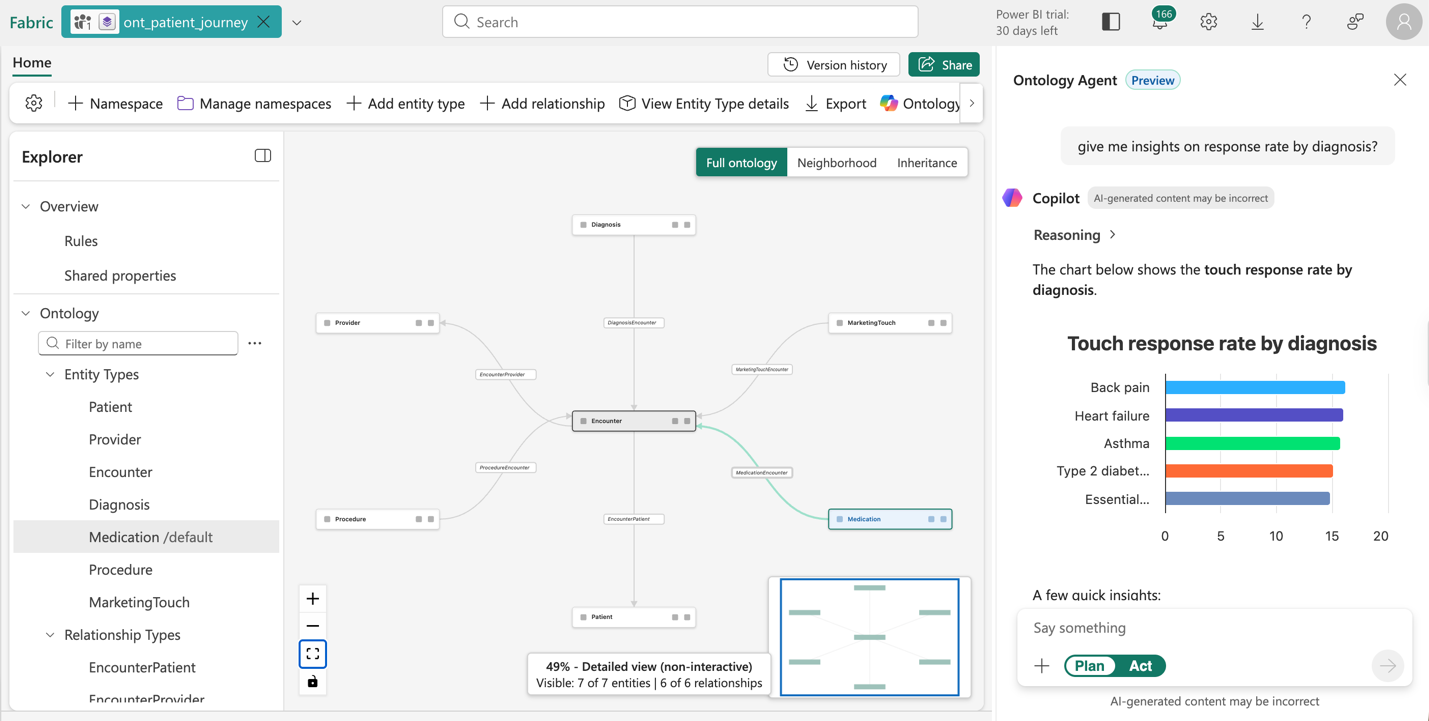
Where data agents help and where review remains necessary
Data agents provide an interface for asking questions about data through prompts. They can reduce the need for an analyst to translate every business question into a query, potentially allowing an executive or operational user to explore details directly. That convenience depends on the configured sources, supported interface and quality of the underlying model.
A data agent may use an ontology as context, drawing on definitions and relationships among entities. In Microsoft’s documented preview integration, the ontology supplies semantic context and the agent generates a query for an underlying source. The agent’s interface and customization options do not replace access controls. Microsoft states that Fabric data agents honor the requesting user’s data permissions, and users still need access to the relevant underlying sources.
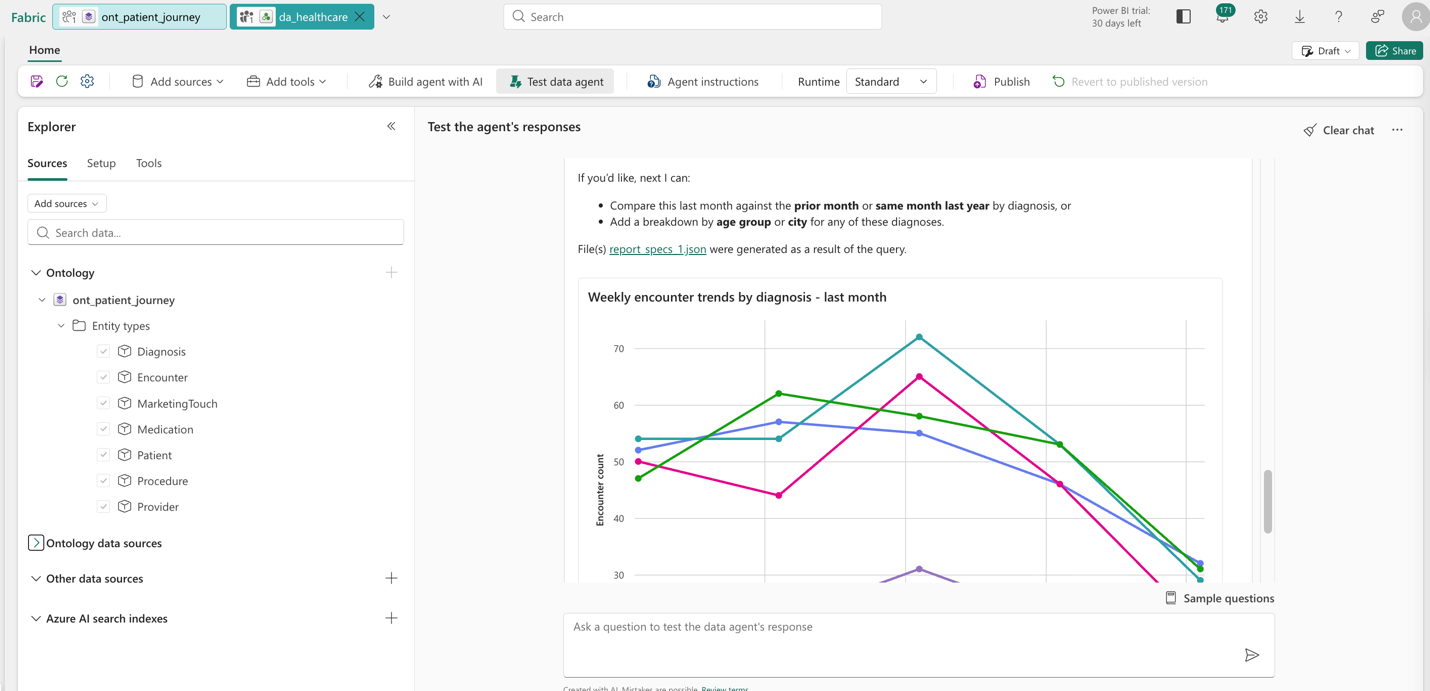
Possible questions include which patients missed checkups, how outreach related to subsequent visits, how workloads varied among clinicians and hospitals, and when demand was busiest. An organization could also investigate potentially avoidable utilization and costs, using agreed definitions and appropriate clinical review. Forecasting busy periods requires a validated forecasting method beyond simply displaying historical counts. The chat interface adds a way to explore these questions alongside established reporting.
What comes next
Ontology and data agents provide additional ways to work with patient data, connecting business context with questions asked on demand. Understanding those patterns matters for three reasons.
- A strong data foundation remains necessary, because the AI layer depends on the completeness, quality and meaning of the data beneath it.
- Cross-domain analysis and questions on demand can change how frequently healthcare organizations seek feedback and investigate service quality.
- Implementation choices bring different costs and risks. Identifying those risks early can avoid expensive rework, although there is no universal cost multiplier.
The next article examines how to test these tools and move from prototypes toward controlled use. That work connects the opportunities described here with explicit measures of accuracy, consistency, cost and operational readiness.