The patient journey as data
Why patient-centric healthcare organizations win by ensuring the reliability of the information on which they base their operations.


Part 1 of a three-part series on patient data architecture.
The scheduling system knows that John missed an appointment. The patient feedback system has a comment from Johnny. An insurance record uses Johnathan. Before anyone can interpret those events as one patient’s journey, the organization has to establish whether the records describe the same person. A name alone cannot settle that question.
That is the job I want a healthcare data platform to do well. Clinical observations, laboratory results, billing records and patient feedback arrive in different formats and serve different purposes. A care coordinator needs to know who missed a screening. An operations manager may need to know how often appointments are delayed. Both should be able to trace their answers to the records that support them.
Keep the source, standardize the data, then answer the question
A design known as medallion architecture separates those jobs across three layers: bronze, silver and gold. The names describe the work done at each stage. They do not grade the importance of the information or determine who should have access to it.
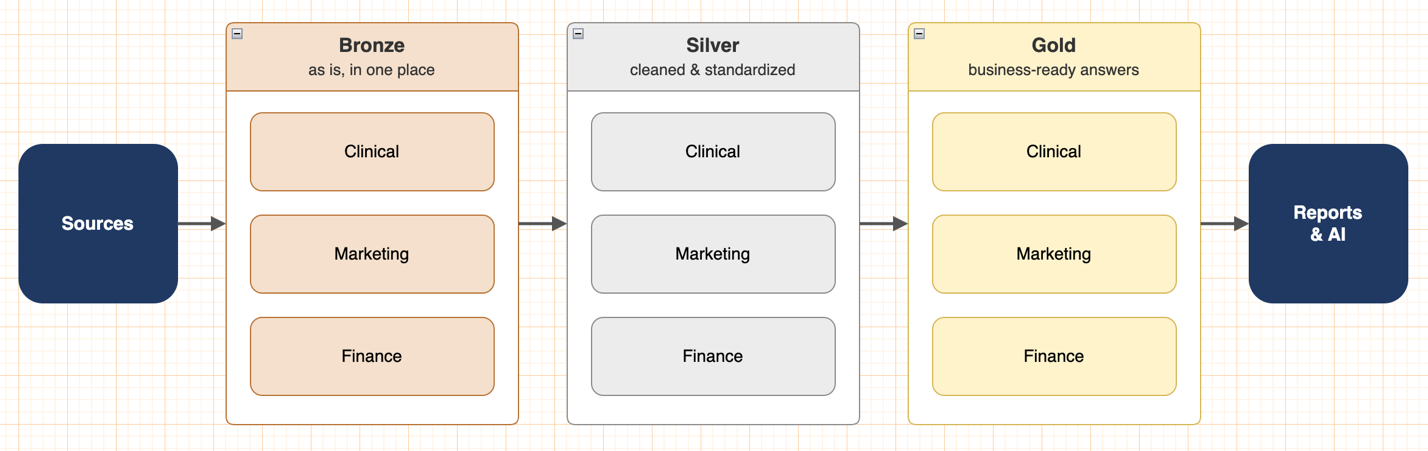
Bronze preserves the source. A laboratory result, an appointment update or a response to an outreach campaign arrives with the identifiers and values the source system supplied. Keeping that history lets an analyst trace an apparent error to its origin. If a definition changes a year later, the team can revisit the original records instead of trying to reverse-engineer a dashboard.
Silver makes records comparable. This is where a team standardizes phone numbers, addresses, codes and dates, removes noise and reconciles identities. A nickname may suggest a match. Other attributes and the organization’s matching rules determine whether records can safely share a patient identifier. When the evidence is ambiguous, leaving a match unresolved is better than attributing one patient’s history to another.
Some systems report each change to a record as a separate event. In that case, the team needs to distinguish an update from a duplicate, retain the sequence in the source layer and identify the current value for the intended use. A shared identifier and consistent definitions give downstream teams building blocks they can reuse.
Gold serves a particular decision. The care coordination team may want a worklist of people overdue for a screening. A clinician may need recent observations and laboratory results. The two products can draw from the same standardized records while presenting different information to their users.
Choose storage and access to fit the job
The pattern does not require a particular vendor. A team can implement the transformations with Spark notebooks in Fabric or Databricks, SQL in Snowflake or stored procedures in SQL Server. Microsoft’s Fabric tutorial, for example, illustrates how data move through the three layers. The important design decision is which version of a record each layer preserves and how a user can trace a result back to its source.
Protected health information deserves a separate access decision at each stage. Preserving identifiable source data for authorized users does not mean copying every identifier into every report. Define what the recipient needs for the task, restrict access accordingly and maintain a record of who used the data.
Build different views on the same foundation
Operations staff may need appointment capacity, no-shows and wait times. An outreach team may need campaign responses and portal engagement. Finance may need claims, denials and revenue by service line, while quality teams need screening rates and care gaps across a population. Executives may need only a few measures. For compliance staff, the question may be who accessed a protected record and when.
A shared silver layer makes it easier to explain why two reports agree or differ. If the care coordination team changes its follow-up interval, its worklist can change without requiring finance to rebuild its claims report. If the patient match itself is wrong, the team can investigate that shared input and identify which reports need correction.
What this changes for AI
Quality managers sometimes use a 1–10–100 rule of thumb to illustrate why errors become more expensive downstream. The figures are a heuristic, not measured costs for a healthcare system. The patient example gives the principle a practical meaning: correcting an uncertain match before publishing a worklist can spare several teams from acting on the same mistake.
AI makes that traceability more important. A data agent that retrieves an answer quickly can still retrieve the wrong patient’s history. In the next installments, I will examine how an ontology can describe relationships among these records and how a data agent might use the gold layer to answer a question whose underlying records can be checked.
Iur
Author disclosure: Iurchenko reports writing the manuscript himself and using Grammarly for polishing. He used AI to brainstorm gaps and help convert a prompt into a diagram, and reports using synthetic data for his illustrations. HDM created the separate cover illustration.