From API Connectivity to Workflow: The Electronic Prior Authorization Burden Test
A prior authorization API can pass every conformance test and still leave care teams worse off. Here is a practical test for whether electronic prior authorization reduces provider burden.

This is Part 2 of a three-part series. Read Part 1 on the accountability gap across payers, providers and vendors.
In the summer of 1988, my twin brother and I built a billing system on an IBM XT in my father’s ophthalmology practice in Houston. I handled the insurance calls. Long before I started my career in healthcare data and payer operations, the front desk taught me something that still holds: a process can satisfy an insurer and bring a clinic to a standstill.
That distinction matters as payers implement the federal prior authorization final rule. Beginning in 2027, affected payers must make electronic interfaces available to identify services that require authorization, describe the documentation needed and exchange requests and decisions. The compliance date depends on the payer and, for some plans, the start of the rating period or plan year.
On the clinical side, federal certification criteria give electronic health record developers a way to support three distinct tasks: checking coverage at order entry, collecting documentation and submitting the request. The criteria also address subscriptions for status updates. The government subsequently adopted updated standards for the HL7 Da Vinci implementation guides. A successful exchange shows that two systems can communicate. It tells us very little about how many times a nurse had to type the same information.
What the wait costs a clinic and its patients
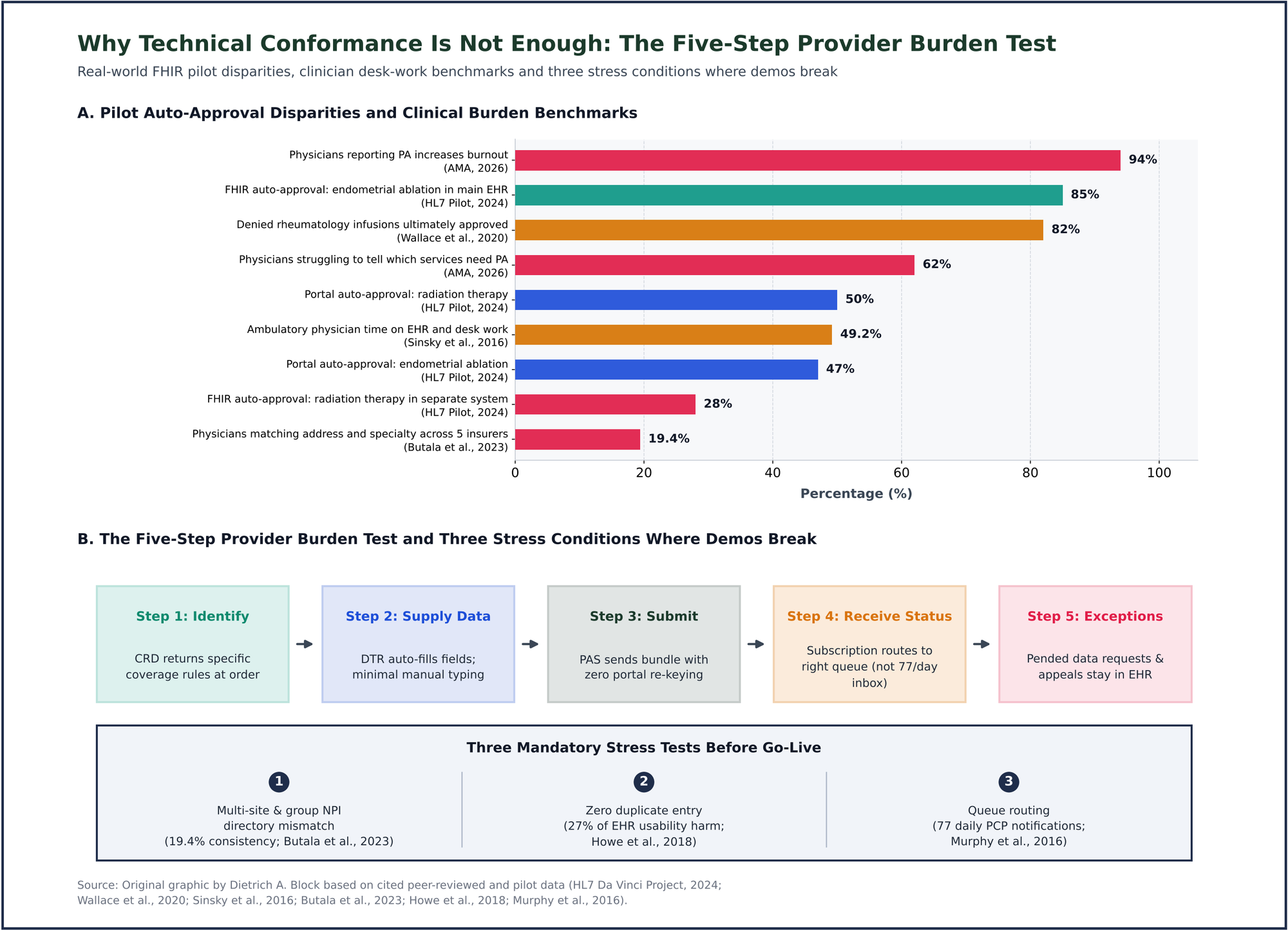
Prior authorization affects two goals of the Quintuple Aim: a better patient experience and a workforce able to sustain the work. In the American Medical Association’s 2025 physician survey, respondents reported an average of 40 requests per physician each week and 13 hours of physician and staff time spent on them. Ninety-four percent said the process contributed to burnout. That work lands in an already crowded day. In a four-specialty time-motion study, ambulatory physicians spent 49.2% of office time on electronic records and desk work and 27% in direct face time with patients.
In a rheumatology cohort study, patients whose infusion requests were initially denied waited a median of 50 days for treatment, compared with 27 days for those whose treatment required no authorization. Ultimately, 82% of initially denied requests were approved. A scoping review of neurologic medications also identified care delays for patients and time demands for clinicians. An American Heart Association collaborative has called for automating authorization inside the clinical record.
Where electronic connectivity falls short
An electronic workflow can reproduce an old bottleneck. In one health system, a medication study found that prescription filling did not improve after electronic authorization was introduced. The 2024 CMS rule excludes drugs, and the agency’s 2026 drug proposal would address them separately. The implementation question carries over to medical services: can the ordering team complete the work where it already practices?
A Da Vinci pilot report shows how much depends on where the data reside. For endometrial ablation, the electronic workflow automatically approved 85% of requests, compared with 47% on the portal. For intensity-modulated radiation therapy, the electronic rate was 28%, compared with 50% on the portal. Some of the oncology notes needed for review were in a separate specialty system beyond the pilot’s reach.
Five steps to test from the ordering clinician’s screen
Run a request from order entry through the final decision with the people who do the work. The following five checks show where an apparently successful transaction can shift work back to the clinic.
- Check coverage at order entry. Does Coverage Requirements Discovery return the right answer for this patient and service? In the AMA survey, 62% of physicians reported difficulty determining whether a service required authorization.
- Count what staff must type. For Documentation Templates and Rules, measure the share of required fields populated from the chart. A documentation review found little standardization in how organizations measure that burden.
- Submit from the record. Can Prior Authorization Support transmit the clinical information without someone re-entering it in a portal?
- Follow the response. Confirm that pending, approved and denied updates reach a person who can act on them, including when a contractor conducts the review.
- Test the next exchange. Can staff answer a request for more information or pursue an appeal within the same workflow?
When my team tested interfaces for a multisite medical group, one physician had three provider records tied to different locations and billing identifiers. The interface matched the first record it found. Responses went to an inactive clinic queue while the staff caring for the patient waited.
That experience is why I test three conditions before launch. First, vary the provider identity across sites, group identifiers, and ordering and rendering clinicians. A directory study found that only 19.4% of physicians listed across five national insurers matched on both address and specialty. Second, watch for re-entry of clinical information. In an analysis of electronic record usability reports, data entry accounted for 27% of reports involving potential harm, ahead of alerting and interoperability. Third, trace notifications to the responsible queue. In one inbox study, primary care physicians received an average of 77 notifications each workday.
Measure the work left after the connection goes live
The CAQH Index counted portal-based authorizations as partially electronic, yet providers still spent an estimated 16 minutes and $8.93 per transaction. Before go-live, ask a frontline team to demonstrate a complete case. Record how long it takes, which fields they enter twice and who receives the decision. Those observations tell a clinic more about the value of the connection than endpoint uptime alone.