
CMS-0057-F and the accountability gap across payers, providers and vendors
The rule holds payers accountable for prior authorization outcomes that depend on many organizations; a new ownership model can improve complex workflows.

Early in my career in the 1990s, I worked as a claims examiner and claims auditor at a health plan. Reconstructing a disputed adjustment meant pulling evidence from reel-to-reel tapes, optical tapes, mainframe reports and file cabinets stored under the subfloor and in the ceiling, sliding heavy cabinets on rails like Tetris pieces to reach one folder.
Across 35 years in healthcare data and payer operations, the most difficult part of an audit was never only located inside one department. That's because the breakdown almost always happened at the handoff between departments, where nobody stamped the file.
Finalized by the Centers for Medicare and Medicaid Services (CMS) in February 2024, the Interoperability and Prior Authorization Final Rule (CMS-0057-F) creates that same accountability gap across organizations.
The rule applies directly to Medicare Advantage organizations, state Medicaid and Children’s Health Insurance Program (CHIP) agencies, Medicaid and CHIP managed care plans and qualified health plan issuers on the federally facilitated exchanges. Since January 1, all except federally facilitated exchange issuers had to decide non-drug prior authorizations within 72 hours for expedited requests and seven calendar days for standard requests, give specific denial reasons and publish annual metrics. Beginning Jan. 1, 2027, they must operate a Fast Healthcare Interoperability Resources prior authorization application programming interface (API).
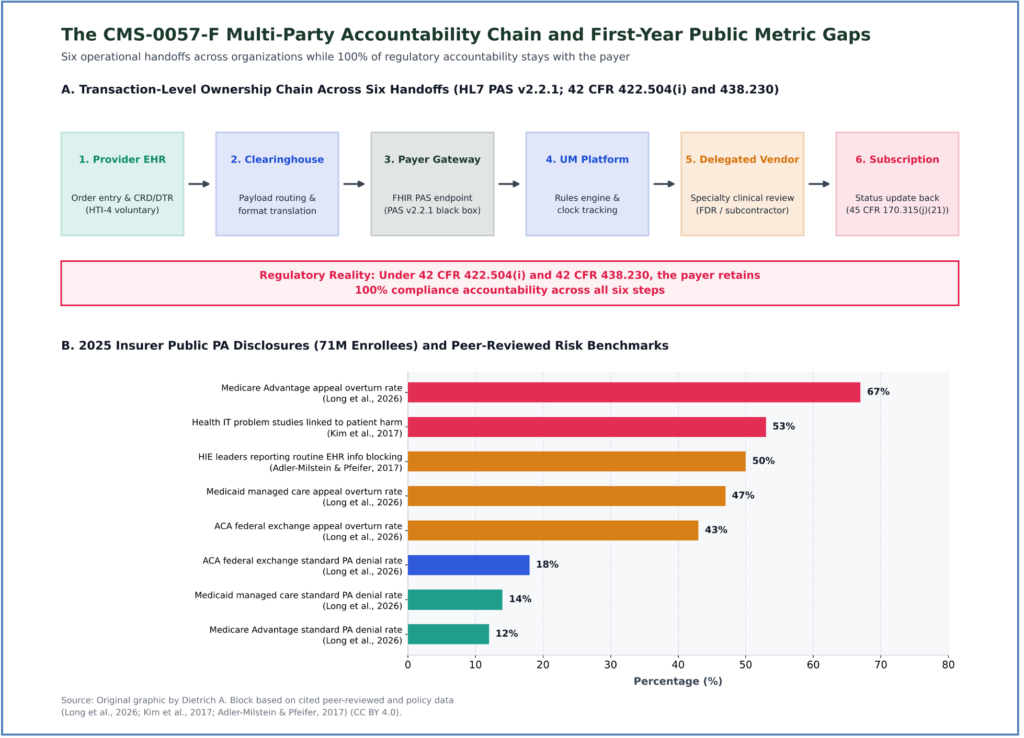
What the rule cannot simplify is the path traveled by a prior authorization request for services when it moves between clinical and payer systems. One service request may cross a provider’s electronic health record, an EHR's FHIR client, a clearinghouse, the payer’s API gateway, a utilization management platform and a delegated review vendor.
Even when external systems perform most of the intermediate steps, the regulated health plan remains responsible for the final turnaround time and decision.
Where technical standards stop
The Health Level Seven International (HL7) Da Vinci prior authorization support implementation guide treats everything beyond the endpoint that receives the FHIR bundle as a black box responsible for meeting regulatory rules and timeframes.
For pended prior authorization requests, the HL7 application requires the requesting system to use a subscription for updates while blocking other systems from subscribing. Whether an EHR displays a decision inside the clinical workflow depends on provider-side capability, while the regulatory turnaround clock runs on the payer’s side.
That technical boundary matters because federal rules bind payers and providers differently. Health plans face a mandatory compliance deadline, while hospitals and medical practices do not.
Under the Health Data, Technology and Interoperability final rule (HTI-4) of the Assistant Secretary for Technology Policy and the Office of the National Coordinator for Health Information Technology (ASTP/ONC), EHR certification criteria for coverage requirements discovery, documentation templates and rules and PAS remain voluntary, so EHR developers aren’t required to build them.
CMS Administrator Mehmet Oz described the work ahead as fixing workflow gaps and handoffs that no single sector can solve on its own.
Delegated review and payer responsibility
Federal rules for Medicare Advantage and Medicaid managed care plans state explicitly that contracting for clinical review services does not transfer compliance responsibility.
Under 42 Code of Federal Regulations Section 422.504(i), a Medicare Advantage organization retains ultimate responsibility for its CMS contract regardless of tasks delegated to first-tier, downstream and related entities through monitored agreements with revocation remedies.
Medicaid managed care rules under 42 CFR Section 438.230 require the same oversight for subcontractors. When a delegated vendor misses the seven-day clock or omits a specific denial reason, the health plan bears the compliance failure.
Health informatics research shows why gaps open when clinical workflows cross company lines. One study models health IT across eight interdependent dimensions, including technology, clinical content, workflow, organizational features and external rules. CMS-0057-F sits in external rules, yet compliance depends on the other seven working across companies.
Another analysis notes that developers and users have long blamed each other for safety breakdowns, calling instead for shared responsibility that defines each party’s operational role.
Standard software contracts and vendor incentives often widen that divide. One research project showed how vendor hold-harmless and confidentiality clauses shift liability to users and limit defect disclosure. In a national survey of health information exchange leaders, half reported routine EHR vendor information blocking. Another analysis found that 53 percent of reviewed studies linked health IT problems to patient harm and death, with access, configuration and update problems delaying care.
A transaction-level ownership model
Departmental reporting lines inside a health plan rarely match the path a prior authorization request takes across clinical review, IT and external contractors.
Unassigned handoffs delay patient treatment, add manual follow-up for care teams and fall hardest on patients with complex needs, undermining the Quintuple Aim of better care, healthier populations, lower costs, clinician well-being and health equity. For each step in the transaction, the health plan should name the regulatory requirement, the internal owner, the organization performing the work and the system log that proves the step finished on time.
A regional health plan with which I worked ran into this exact breakdown when pended specialty-imaging requests came back from its delegated utilization management vendor.
The vendor’s clinical system recorded final determinations on time, and the health plan’s FHIR gateway passed every connectivity test, yet completed decisions sat undelivered for days because the gateway team expected the utilization management platform to push a status event while the platform team assumed the gateway was polling a staging table.
Assigning one team to own the handoff between those two systems and alerting on any pended request that went silent for more than an hour stopped the missed deadlines.
The blind spot in annual public reporting
In an August 2026 KFF analysis of 2025 disclosures from 14 insurers covering 71 million enrollees found standard denial rates of 12 percent to 18 percent, and 67 percent of appealed MA denials overturned, yet public postings gave overall percentages without request counts or service breakdowns and could not reveal missed turnaround clocks.
The April 2026 CMS Interoperability Standards and Prior Authorization for Drugs proposed rule (CMS-0062-P) would add request counts, API metrics and mandatory Da Vinci implementation guides.
Payers, providers and vendors don’t need to wait for another rulemaking cycle to close these gaps. Health plans can start now by mapping each transaction step to a single operational owner, writing turnaround and audit terms into delegated vendor contracts and instrumenting shared logs so teams can see where every clock is running.
Dietrich A. Block, PhD, MBA, MHA, eFACHDM, is the founder and principal consultant at Dietrich Block Consulting, LLC.