Why refugee health remains a blind spot in healthcare data
For refugees and migrants, closing healthcare’s visibility gap requires connected data, thoughtful governance and care pathways that follow patients across settings.

Global forced displacement declined in 2025 for the first time in a decade, but the scale remains extraordinary. At the end of 2025, 117.8 million people worldwide were forcibly displaced, including refugees, asylum-seekers and people displaced within their own countries. The decline from 123.2 million at the end of 2024 reflected large return movements, particularly involving Afghanistan, Syria and Sudan, but UNHCR cautions that many returns occurred under difficult conditions and that displacement remains historically high.
The health implications are equally broad. The World Health Organization describes refugee and migrant health needs across communicable disease, chronic disease, maternal and child health, mental health and injury, while emphasizing that legal, financial, administrative, linguistic and cultural barriers can limit access to care. These risks do not arise because displaced people inherently threaten host populations; they are shaped by disrupted services, hazardous journeys, living conditions and difficulty maintaining continuity as people move.
For health data leaders, that makes the central problem less a lack of clinical knowledge than a lack of visibility. A WHO evidence review found substantial gaps in the availability and integration of refugee and migrant health data across European health information systems, with inconsistent definitions, limited linkage and underused monitoring approaches. The practical result is familiar to anyone who manages population health: organizations may know that a population has elevated needs while still lacking the longitudinal, reliable data required to find individuals, coordinate services and measure whether care actually reaches them.
Health information systems were not built for mobile populations
People who are forcibly displaced may face increased exposure to tuberculosis, vaccine-preventable disease and other communicable conditions because of interrupted services, crowded living conditions and difficulty maintaining vaccination or treatment records across settings. WHO guidance emphasizes that people on the move can struggle with vaccination and continuity of care, while also cautioning against treating refugees and migrants themselves as a communicable-disease threat to host communities.
The COVID-19 pandemic made the structural problem easier to see. WHO has repeatedly argued that refugee and migrant health should be incorporated into mainstream health systems rather than managed through long-term parallel structures, even though emergency circumstances can sometimes require temporary parallel services. That recommendation is less about organizational neatness than continuity: when surveillance, vaccination and clinical records sit outside the systems used for the wider population, information becomes harder to connect as people move between settings.
That lesson extends beyond a single pandemic. A separate service may be clinically necessary in a crisis, but if its data cannot move into the broader health information environment, each transition creates another opportunity for identity, history, eligibility or follow-up information to disappear. For a mobile population, fragmentation compounds quickly.
Access barriers compound the visibility problem
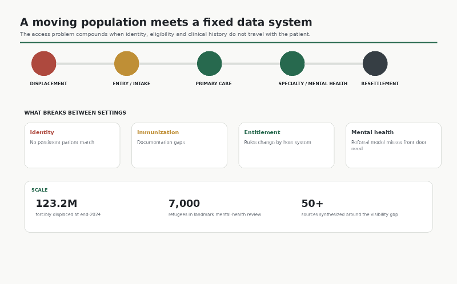
Registration alone does not guarantee access. Across many host settings, refugees and migrants still face financial, transportation, documentation, language and administrative barriers that can delay primary and preventive care. Studies of Syrian refugees in Lebanon and Jordan found substantial use of maternal health services but also significant out-of-pocket costs, while earlier work in Lebanon documented important gaps in the content and adequacy of antenatal care.
Outcomes also vary with the inclusiveness of the host health system and the maturity of local integration efforts. Some settings improve access through interpreters, community health workers and culturally responsive services, while formal legal entitlement may still fail to translate into practical access if patients cannot register, understand the process or afford the care. The data challenge is therefore not only whether an entitlement exists, but whether systems can identify who is eligible, who actually received care and where the pathway broke down.
Noncommunicable disease creates the same continuity problem over a longer time horizon. WHO's NCD review describes how migration can interrupt diagnosis and treatment for conditions such as diabetes and hypertension and how legal status, cost, language and social exclusion can disrupt ongoing care. The issue is not that health systems lack clinical protocols for those diseases; it is that the patient, the history and the treatment plan may not remain visible across the migration cycle.
Mental health shows what fragmentation costs
Mental health is one of the clearest examples of why population averages must be interpreted carefully. A landmark systematic review of 6,743 adult refugees resettled in Western countries found post-traumatic stress disorder in about 9% and major depression in about 5%, with substantial variation across studies; the authors also found higher PTSD prevalence than in age-matched general populations. Those figures should not be generalized to every refugee population, but they demonstrate the scale of need that can remain hidden when trauma history, language and post-migration stress are disconnected from routine intake and primary care.
Evidence-based mental health and psychosocial interventions exist, but access often fails before treatment begins. When mental health is available only through a specialty referral pathway, people facing language barriers, unfamiliar health systems, transportation problems or unstable living conditions have more chances to fall out of the process. A more visible model brings screening, referral status and follow-up into the same operating picture as primary care rather than treating behavioral health as a separate data universe.
What a data-driven response actually requires
Digital tools can help, but the evidence does not support treating technology as a stand-alone solution. A 2025 review of electronic personal health records for mobile populations found several promising approaches but limited evidence on health outcomes and continuity of care, with adoption still a major challenge. Other recent research highlights privacy, consent, digital access and trust as central design constraints, particularly for people whose legal or social circumstances may make inappropriate data sharing consequential.
The stronger model is disciplined integration: an identity strategy that can reconcile records without creating unsafe assumptions, a longitudinal record that can move when policy and consent permit, and analytics that can show where access or follow-up breaks down. That does not mean building a global refugee database, and it does not mean collecting every migration-related attribute simply because it is technically possible; it means deciding which information is clinically and operationally necessary, governing it carefully and making it available to the people responsible for care.
What health data leaders can actually do
Most of the underlying problems are recognizable health data management problems, but the solutions require more than applying a familiar acronym. Patient matching and longitudinal identity management can reduce duplicate or fragmented records, while standards such as HL7 FHIR can support exchange between systems that have agreed on governance, consent, terminology and security. FHIR does not solve cross-border identity by itself, and a master patient index cannot overcome incompatible legal frameworks; the technical layer works only when policy and operating agreements travel with it.
Population-level analytics can also help leaders understand where access breaks down, but they should be used with the same privacy discipline applied to other vulnerable populations. Geospatial and small-area methods can identify service deserts or gaps in vaccination, chronic disease follow-up or mental health access without turning analytics into a tool for locating or profiling individuals. The opportunity is not exotic technology; it is the standard data management toolkit applied with stronger attention to mobility, trust and governance.
Priorities for healthcare executives
Recommendations and next steps
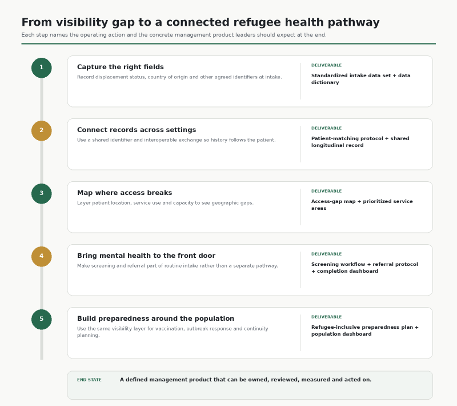
Immediately, health systems should audit which displacement- and migration-related data elements are actually necessary for care and whether they are captured consistently. Country of origin, preferred language, prior care setting or other variables may be useful in some workflows, but legal status and similarly sensitive information should not be collected reflexively; leaders should establish a clear purpose, access controls, retention rules and patient-facing explanation before adding any field. The first goal is better care and continuity, not a larger demographic profile.
In the near term, organizations should work with resettlement agencies, public health departments and community partners to improve record continuity rather than automatically creating another proprietary registry. A shared dataset, referral-status exchange or linked longitudinal record may be appropriate where governance, consent and local law support it. Whatever model is chosen, it should follow the patient across the settings that actually participate in care and should have an explicit owner for data quality, identity resolution and access.
Longer term, healthcare organizations should bring refugee and migrant inclusion into preparedness, surveillance and population-health planning before the next emergency. The policy lesson from COVID-19 is not that parallel services are never needed; it is that emergency services should connect back to mainstream systems as quickly and safely as possible. Health data leaders can contribute by testing whether preparedness plans include the identifiers, translation resources, exchange pathways and reporting logic needed to see mobile populations when a crisis begins.
Visibility has to exist before the crisis
Displacement remains far too large and dynamic for health systems to treat it as a temporary exception. UNHCR reported 117.8 million forcibly displaced people at the end of 2025, even after the first annual decline in a decade, and many returns occurred under conditions in which housing, infrastructure and basic services remained fragile. The organizations best positioned to respond will not necessarily be those with the largest technology budgets; they will be the ones whose data, governance and care pathways are prepared to recognize a moving population without losing the person in the movement.
Visibility is the first problem in equity work, whether the population crossed a border last month or has lived two counties away from the nearest clinic for generations. Part two of this series turns to a domestic example in which people are counted by government systems, but the available information is still not compared and connected in ways that consistently expose the gap.
Julia Rehman, DHA, FACHE, FACHDM, is Founder and Chief Operating Officer of Kota Kompany LLC, where she advises health systems and public-sector organizations on strategic transformation, governance, operational performance and executive leadership.