Why health systems are taking specialty pharmacy in-house
The decision involves more than gaining control over their own supply chain. It enables organizations to control critical data.

The previous article in this series showed how little visibility health systems, employers and patients have into what pharmacy benefits management companies actually charge for specialty drugs.
A growing number of health systems have stopped waiting for that visibility to arrive and started building their own specialty pharmacy infrastructure instead.
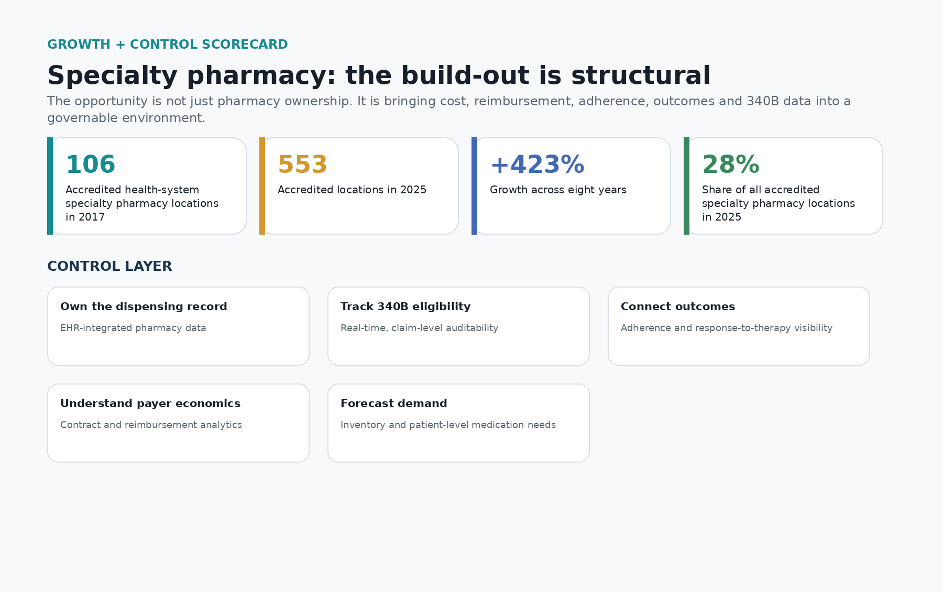
Recent reporting indicates that the number of accredited specialty pharmacy locations owned by hospitals and health systems grew from 106 in 2017 to 553 in 2025, now representing 28 percent of all accredited specialty pharmacy locations nationwide.
That kind of growth is structural rather than incremental. Averaged out, health systems opened roughly 56 new accredited specialty pharmacy locations a year, every year, for eight straight years. That is not a pilot program; it is a sustained build-out that shows no sign of leveling off.
What's driving this growth
The single largest driver is 340B Drug Pricing Program margin capture, ahead of patient convenience or care coordination, although a health system typically gets some of both as well.
Drugs dispensed through a health system's own pharmacy are unambiguously eligible for 340B pricing, while manufacturer restrictions on contract pharmacy arrangements, a policy fight that has moved through multiple federal circuit courts, have made external specialty pharmacy relationships increasingly unreliable for that same purpose.
Examples of actual investments in specialty pharmacy operations illustrate the scale of this shift. UVA Health opened a 40,000-square-foot central pharmacy services center as a hub for its retail, specialty, and home delivery operations. WVU Medicine converted a former pharmaceutical manufacturing plant into a 25,000-square-foot centralized hub, reporting $620,000 in drug shortage savings in its first year. Inova Health opened a 72,000-square-foot facility combining specialty, retail and mail-order operations under one roof. Eskenazi Health built a $10 million central fulfillment center designed to fill 60 percent of the health system's prescriptions within five years.
It's control, not just ownership
Building an in-house specialty pharmacy does not automatically deliver better data governance. It creates the opportunity for it.
Health systems taking this step are not merely bringing pharmacy operations inside their own walls. They are bringing acquisition cost, reimbursement, adherence, outcomes, formulary intelligence and 340B data into an environment they can govern, rather than one a PBM governs on their behalf.
Capturing that opportunity requires real infrastructure, such as EHR-integrated dispensing records, real-time 340B eligibility tracking, payer contract analytics and formulary decision support built on the health system's own outcomes data rather than a vendor's proprietary algorithm.
A 2024 national survey identified 298 distinct health-system specialty pharmacies now tracking patient-level outcomes, with nearly all of them monitoring response to therapy in some form, evidence that the sector has scaled well past the pilot stage. There's still a wide gap between owning the pharmacy and owning the data pipeline behind it at many organizations.
Despite the growth, concentration at the top of the market has not meaningfully changed. The three largest specialty pharmacies, all affiliated with a PBM, still account for roughly two-thirds of total specialty drug dispensing revenue.
Where AI and automation prompt change
Owning the pharmacy also opens the door to automation that most health systems could not access as a client of a PBM. HRSA's own 340B program rules require covered entities to maintain auditable records, prevent duplicate discounts and be prepared to demonstrate compliance on every claim, an audit standard that manual sampling of 3 percent to 5 percent of claims was never really built to meet.
AI and automation tools now make comprehensive review of a much larger share of 340B claims realistic than manual sampling ever allowed, which matters directly for audit defensibility under those same HRSA requirements.
The same logic extends to inventory and adherence. AI-augmented demand forecasting, already used across pharmaceutical supply chains, can help a health system's specialty pharmacy anticipate patient-level medication needs and reduce the carrying costs and shortages that come with managing high-cost, low-volume drugs by hand.
Priorities for healthcare executives
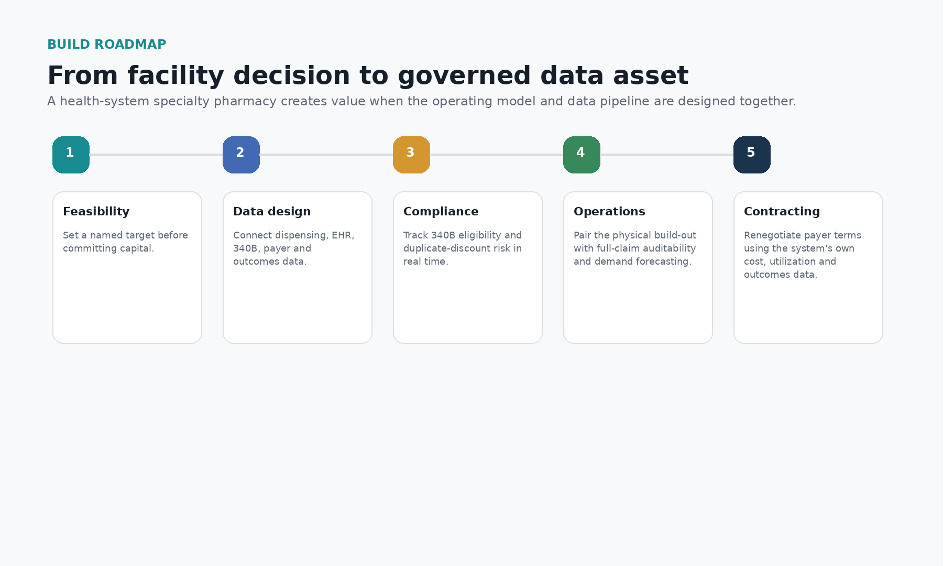
Health systems that treat this choice as a decision only involving physical build-out, square footage, staffing and equipment, are underselling what they are actually doing. The organizations capturing the most value are the ones building governance and analytics into the pharmacy from Day 1, not just relocating where a prescription gets filled.
Bringing specialty pharmacy in-house does not guarantee transparency. It gives health systems the opportunity to create it. The organizations that capture the greatest value will not simply own the pharmacy. They will own, govern and act on the data flowing through it.
Owning the data solves one problem, but it creates another responsibility, which is using it correctly. The third article in this series turns from pharmacy to the No Surprises Act to examine what happens when a major healthcare system is built on a forecast derived from the wrong population.
Julia Rehman, DHA, FACHE, FACHDM, is founder and chief operating officer of Kota Kompany LLC.