
When a member month is not a member month
Why treating 820 payment data as enrollment, eligibility or claims exposure can distort healthcare financial and performance reporting.

A member month sounds simple: one covered person for one month. Across health plans, accountable care organizations and analytics environments, however, the same label can be attached to very different populations: enrolled members, eligible members, members associated with premium activity, members represented in an 820 payment transaction or members included in a claims denominator. Those populations are related, but they are not interchangeable, and the difference can materially change what an executive dashboard appears to say.
The distinction matters because member-month denominators sit beneath some of healthcare's most consequential operating measures. Medical cost per member per month, utilization per 1,000, capitation reconciliation, actuarial experience analysis and contract performance can all move when the denominator changes even if the underlying claims or utilization do not. A field can therefore be technically populated, reconciled and traceable to a source transaction while still being semantically wrong for the decision it is supporting.
The ASC X12 820 is authoritative evidence of a premium-payment or remittance transaction within the business context in which it is used. CMS describes the adopted 820 standard as a transaction for initiating premium payments and transmitting remittance and payment-processing information. It is not, by itself, universal proof of enrollment, current eligibility, full premium satisfaction or inclusion in the population that should be used with incurred claims.
The terminology problem
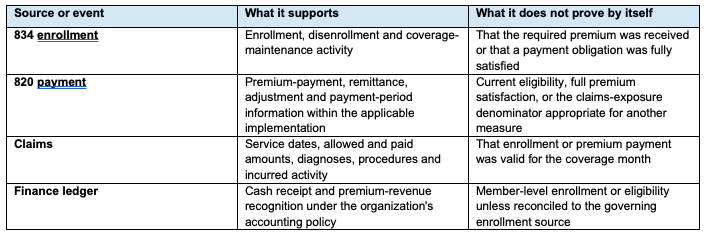
HIPAA treats premium payment and enrollment as different administrative transactions for a reason. The adopted 820 standard communicates health plan premium-payment information, while the 834 standard communicates enrollment and disenrollment information used to establish, change, reinstate or terminate coverage. Claims data establish service and incurred activity, while an organization's finance records establish cash and premium-revenue recognition under the applicable accounting policy.
Confusion often begins when an analyst derives one record for each person and coverage month appearing in an 820 extract and labels the result “incurred member months.” The phrase sounds plausible because the resulting field may later be joined to incurred claims, but the word incurred describes the claims or services, not the member. Current CMS rate-review instructions deliberately keep those concepts separate: incurred claims and other experience-period amounts are divided by a separately defined experience-period member-month denominator.
For plan year 2027, CMS defines member months in the Unified Rate Review process as the total months of coverage during the experience period for members with applicable single-risk-pool coverage. A member covered for five months contributes five member months, with the issuer applying a consistent methodology for partial months. That definition illustrates the governance point: the denominator is tied to a coverage rule and reporting period, not inferred from the presence of a payment line.
What each source actually establishes
The safest way to prevent semantic drift is to begin with the business event represented by each source. None of the sources below is inherently “better” than the others; each is authoritative for a different question. Problems arise when one source is silently promoted into an answer for a question it was not designed to settle.
A coverage period is not the same as an eligibility determination
An 820 can contain enough information to associate a payment with a specific coverage period, but that association needs to be interpreted inside the implementation guide that produced the transaction. In an official X12 Health Insurance Exchange 820 example, DTM qualifier 582 with an RD8 date range identifies the coverage period to which a payment detail applies. Other X12 820 examples use the same qualifier to identify a premium-payment period.
That does not turn the 820 into an enrollment transaction. A coverage-period reference establishes when the payment information applies; it does not necessarily establish that a person remained actively eligible after retroactive enrollment changes, that every amount due was fully satisfied or that the record belongs in the denominator for a particular claims or utilization metric. The governing 834, eligibility process, trading-partner rules and reconciliation logic still matter.
The distinction becomes especially important because payment transactions can include adjustments and can arrive on a different timeline from enrollment changes. Retroactive additions and terminations can change the valid coverage period, reversals can offset prior transactions and grace-period or program-specific rules can leave coverage status unresolved while payment activity is still present. A raw count of positive 820 member lines can consequently overstate or understate the population depending on how timing and adjustments are handled.
Federal standardization does not erase program-specific meaning
The 820 is a federally adopted HIPAA standard, but a standardized transaction can still be used inside different business programs and trading relationships. Federal rules establish the electronic format for health plan premium payments; companion guides, contracts and program rules determine which entities send the transaction, which payment categories are present and how the receiving organization should reconcile them. That is why an enterprise data model should preserve the transaction's source and implementation context rather than treating every 820 as a universal business event.
CMS itself distinguishes these roles. Its transaction guidance lists premium payment and enrollment/disenrollment as separate HIPAA administrative transactions, and Marketplace enrollment materials continue to use 834 files to communicate enrollment activity to issuers. The practical governance rule is simple: use the 820 to answer payment and remittance questions unless a documented reconciliation rule has established how it relates to another business concept.
How a naming error becomes a reporting error
The label applied to a derived field influences how downstream users treat it. When a field is called “incurred member months,” an analyst may reasonably assume it is the approved denominator for incurred claims; a report developer may reuse it for emergency-department visits per 1,000; finance may interpret it as recognized premium membership. Executives can then compare the resulting metrics without realizing that each number rests on a different population rule.
The error is semantic before it is mathematical. Once a familiar label reaches a governed dashboard, users tend to assume that the underlying definition has already been resolved, and the same field begins to propagate into formulas, reconciliations and contract discussions. By the time the discrepancy is discovered, the organization may have several technically consistent reports that disagree because they never shared the same denominator.
The PMPM distortion can be material
Consider a simplified example. Assume a plan records $12 million of incurred medical claims for a month, and the governed eligibility process establishes 10,000 valid member months. The resulting medical cost is $1,200 PMPM. If a payment-derived extract contains only 9,200 member-month records because of payment timing, reversals or other adjustments, dividing the same $12 million by that smaller population produces approximately $1,304 PMPM.
Nothing about the underlying medical utilization changed, yet the apparent cost increased by roughly 8.7%. The arithmetic is correct in both calculations; the business meaning is not. That is why denominator governance has to occur before a metric is certified, not after an executive notices that two reports disagree.
The same error can distort utilization and revenue views
Utilization measures have the same vulnerability. Admissions, emergency-department visits, skilled-nursing utilization and other rates per 1,000 are comparable only when the event population and member-month denominator use compatible eligibility, product and time-period rules. A payment-derived denominator can make operational performance appear worse simply because fewer member months were counted.
The reverse error is possible as well. A payment record may appear before a retroactive termination is fully reflected downstream, or an adjustment may refer to a prior coverage period. Treating every payment-associated record as one currently active member month can inflate membership, move activity into the wrong reporting period or create an apparent mismatch between premium and claims.
A classification framework can prevent ambiguity
The organization should therefore name each member-month measure according to the business event and rule it actually represents. Some of the labels below are established regulatory or actuarial concepts; others are recommended governance labels intended to keep source-derived measures from being mistaken for broader enterprise definitions. The point is not to create more terminology than necessary, but to prevent one generic MemberMonth field from carrying several incompatible meanings.
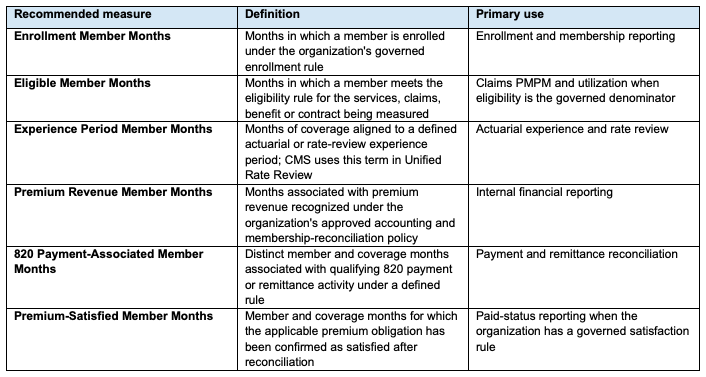
The last two labels are intentionally narrow internal governance terms, not federal X12 or CMS measure names. “820 Payment-Associated Member Months” is appropriate when the organization knows that a member-month record is tied to qualifying payment activity but has not established that all premium obligations were satisfied. A broader label such as “Premium-Satisfied Member Months” should be reserved for a governed reconciliation rule that accounts for amounts due, payment sources, adjustments, reversals, grace periods and retroactive enrollment changes.
The governance controls that should accompany the metric
A technically correct definition still needs operating controls if it is going to function as an enterprise KPI. For a high-risk denominator such as member months, the governing metadata should be explicit enough that Finance, Actuarial, Operations, Quality and analytics teams can independently reach the same interpretation. The following checklist is deliberately structured because each item should be documented rather than left implicit.
Business definition: State the business event that causes a member month to be counted and the events that reverse or restate it.
Source designation: Identify which source is authoritative for enrollment, eligibility, payment, accounting and other components of the rule.
Time basis: Keep coverage month, payment-received month, service month and accounting period distinct.
Adjustment logic: Define treatment of retroactivity, duplicates, partial payments, refunds, reversals and grace-period or program-specific adjustments.
Population alignment: Require the numerator and denominator to represent compatible products, contracts, benefits and reporting periods.
Lineage and certification: Preserve the source fields, transformation rules, decision owner, approval status and effective dates behind the published KPI.
A four-question validation test
Before a member-month measure is approved for enterprise use, the governance team should be able to answer four questions without ambiguity. Because these questions form a compact validation test rather than narrative analysis, keeping them as a numbered sequence makes the control easier to apply repeatedly.
What real-world event does one row represent?
Which source is authoritative for that event?
Which date determines the reporting month?
Would Finance, Actuarial, Operations and Quality interpret the label the same way?
If the answers are unclear, the problem is not merely documentation. The metric is not yet governed well enough to support an enterprise decision. A field should remain narrowly named after its source or derivation until the organization has explicitly approved the broader business meaning.
The larger lesson is semantic governance
Healthcare organizations invest heavily in moving data while often underinvesting in preserving meaning. The 820 example shows why technical ingestion is not the same as semantic governance: a transaction can parse correctly, balance mathematically and pass reconciliation controls while still being used incorrectly downstream. The same problem appears anywhere a source-system label is allowed to become an enterprise metric without a governed definition.
A source file does not determine a KPI's meaning by itself. The business event represented by the source, the accounting and eligibility rules applied to it, the reporting period and the decision the measure will support all have to be connected explicitly. That connection is what turns a field into a trusted enterprise measure rather than a convenient column name.
The broader governance failure is labeling first and defining later. A report developer should not select a familiar term simply because it sounds close to the source data, and a vendor should not rename a field without documenting the business event and approved downstream use. Once a casual label reaches an executive dashboard, it begins to behave like an official definition whether anyone formally approved it or not.
Before a measure appears in enterprise reporting, its name, definition, authoritative sources, time basis, adjustment logic, decision owner and approved uses should be explicit. If those elements remain unsettled, the safer approach is to preserve the narrower source-based description until the business meaning has been governed.
For leaders, the practical question is therefore not simply whether the organization has member months. It is which member months, derived from which event, for which period and governed for which purpose. A convenient report label should never be allowed to become an accidental enterprise definition.
Uzma Jilani, eFACHDM, is Senior Director of Data Management and Operations at Navvis, where her work focuses on healthcare data strategy, governance and trusted performance measurement.