
What 27,000 safety events revealed about rural and Tribal health data
Rural and Tribal health leaders need more than shortage and safety data—they need current, comparable information that turns visibility into management action.

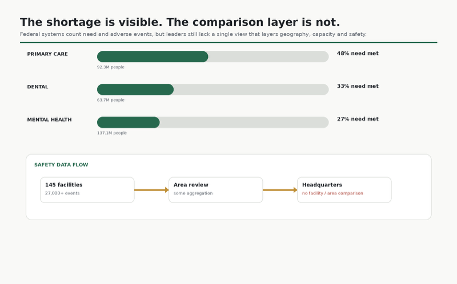
The latest federal shortage data make the scale of the access problem difficult to miss. As of June 30, 2026, HRSA data identified 9,003 primary medical Health Professional Shortage Area designations covering about 108.6 million people, with 47.4% of calculated primary-care need met. The same report identified 7,951 dental HPSAs covering 76.8 million people with 33.6% of need met, and 7,109 mental-health HPSAs covering 157.1 million people with 26.5% of need met. Those populations overlap, so the figures should not be added together, but they show how widely different kinds of shortage can coexist.
This is not primarily a story about missing data. Federal agencies are actively measuring shortages, facilities are reporting safety events and health systems are generating operational information every day. The more difficult question is whether those data are current, comparable and reviewed at the level where leaders can decide what to do next. That makes this a data-governance problem as much as a data-collection problem.
Even the shortage maps require continuous maintenance
HRSA designates Health Professional Shortage Areas using provider counts, population data, geography and access calculations that must be refreshed as underlying conditions change. In July 2026, HRSA extended review of certain designations identified through its 2025 National Shortage Designation Update, which applied updated demographic and provider information including changes associated with 2020 Census geographies. Rather than immediately withdrawing those designations, the agency kept them in a proposed-for-withdrawal status while state Primary Care Offices review boundaries and submit revisions.
That update is a reminder that shortage designations are management data, not permanent labels. In the June 2026 report, 61.3% of primary-care HPSA designations were classified as rural, along with 64.1% of dental designations and 60.4% of mental-health designations. Because more than 34 federal programs use shortage or underserved-area designations to determine eligibility or funding preference, changes in the denominator, provider count or geographic boundary can have operational consequences far beyond the map itself.
The comparison layer matters because each shortage category tells a different story. A county can face a primary-care shortage, a dental shortage and a mental-health shortage at the same time, yet federal reporting still presents those disciplines in separate tables and datasets rather than as one management view for a local executive. Health systems and public agencies can create that layered view themselves, but doing so requires deliberate data integration and a refresh process that keeps pace with HRSA's changing source data.
The sharper governance lesson sits inside the Indian Health Service
The Indian Health Service provides a comprehensive health-service delivery system for approximately 2.8 million American Indians and Alaska Natives who belong to 575 federally recognized tribes. The system includes federally operated facilities as well as tribally operated and urban Indian programs, so findings from federal IHS facilities should not be generalized to every Tribal health organization. The health disparities themselves remain substantial: an IHS quick-look fact sheet reports life expectancy for American Indians and Alaska Natives at 65.2 years, 10.9 years below the U.S. general population estimate cited by the agency.
The 27,000-event finding came from a specific federal patient-safety dataset. In a 2023 GAO audit, 145 federally operated IHS facilities recorded more than 27,000 adverse events and good catches in the IHS Safety Tracking and Response system between August 2020 and July 2022. At the time of GAO's review, facilities investigated events and area offices could review information, but headquarters reporting did not include the area-level trend comparisons needed to determine whether patterns were isolated or recurring across locations.
Local context still matters, and comparison should not erase the differences among facilities or Tribal communities. But comparison is what allows a headquarters team to know when a local event is part of a wider pattern, which areas may need additional attention and where a practice developed in one location should be shared elsewhere. That is the distinction between collecting incident data and using incident data as a management system.
The IHS case is also important because the governance gap did not remain static. GAO now lists both recommendations from the 2023 audit as implemented: by 2024, IHS had developed quarterly reporting with area-level trends and headquarters review, and by April 2026 it had documented actions to address identified trends and disseminate best practices. What began as an example of data that existed without a comparison layer became an example of how governance can change when ownership, review cadence and action are made explicit.
Resources still shape what data governance can deliver
Funding remains part of the context, but comparisons require care. A 2018 GAO comparison using 2017 data calculated per-capita spending of $4,078 for IHS, compared with $8,109 for Medicaid, $10,692 for the Veterans Health Administration and $13,185 for Medicare. GAO cautioned that the four programs differ substantially in structure, populations served and services financed, so those figures are useful as historical context rather than a current apples-to-apples measure of adequacy.
The more current budget picture shows continued federal investment without providing a directly comparable per-capita benchmark. The FY 2026 budget proposed $8.1 billion in total IHS funding, $921 million above the FY 2025 enacted level, while the agency continues to identify staffing, facilities and infrastructure as major operational needs. For data leaders, the practical lesson is that dashboards and governance processes still depend on people, analytics capacity and systems capable of turning reporting into action.
The strongest case for investing in data governance therefore does not require claiming that a historical per-capita ratio remains unchanged today. It rests on a simpler operational point: when resources are constrained, leadership needs more precise comparative information, not less, because each staffing, quality-improvement and infrastructure decision carries a larger opportunity cost. The 2023 adverse-event audit showed what can happen when that comparison layer is missing, and the closed recommendations show that the gap was fixable.
This is a governance problem, not a data shortage
GAO did not find that IHS lacked patient-safety data; it found that headquarters was not regularly reviewing and comparing that data at the area level. That is a classic governance problem: deciding who reviews which measures, how often, at what level of granularity and what happens when a trend crosses a threshold. IHS's subsequent response demonstrates the operating model in practice: standardized reports, recurring headquarters review and a defined mechanism for acting on patterns and disseminating best practices.
The HPSA issue is related but technically different. There, the core problem is reference and master-data maintenance: population, provider and geography inputs must stay current enough for designations to reflect real conditions, and local leaders need a way to combine separate primary-care, dental and mental-health outputs into one decision view. The July 2026 extension of certain HPSA reviews shows why refresh cadence and data lineage matter; a designation can influence workforce programs and payment while the underlying geography is still being reconciled.
Priorities for healthcare executives
Recommendations and next steps
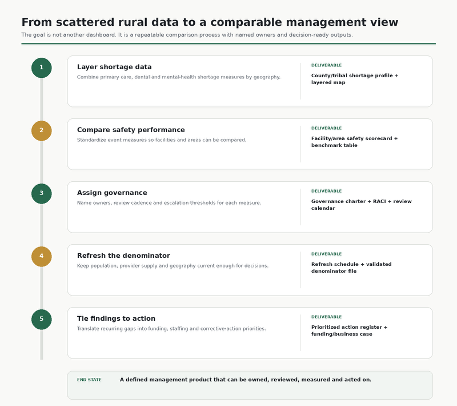
Immediately, leaders should compare their own shortage and quality data with the surrounding geography rather than viewing each measure in isolation. HRSA's current files make primary-care, dental and mental-health HPSA data available for local analysis, while IHS leaders can use the area-level patient-safety reporting architecture that now exists to understand how a facility's pattern compares with the wider system. The first management question is not whether a federal dashboard exists; it is whether the organization has created the comparison that its own decisions require.
In the near term, organizations should build a single management view that layers shortage designations, population denominators and selected quality or safety measures over the same geography. The goal is not another public-facing dashboard for its own sake, but a repeatable view that shows where several forms of scarcity coincide and where a change in the underlying HRSA data alters the priority. Each measure should have a named owner, a refresh schedule and a documented source so that leaders know when the view is stale.
Longer term, the IHS experience offers a more useful lesson than simply citing an open federal recommendation, because those recommendations are now closed as implemented. Leaders can use the case to justify governance positions, standing review forums and escalation rules by showing that federal auditors identified a comparison failure, the agency changed its reporting process and subsequent review documented action based on those trends. That is the management product health data teams should be building: not merely a larger dataset, but a defined process that can be owned, reviewed, measured and acted upon.
The same visibility problem, closer to home
The refugee and Tribal health stories share a root problem but not the same technical failure. In Part 1, the challenge was continuity across movement, identity and jurisdictions; here, the sharper problem is whether existing federal and local data are current, comparable and converted into management action. One population can become invisible because records do not travel, while another can remain underserved even when substantial federal data already exist.
Part three of this series turns to a different setting: a Gulf health system serving a large expatriate workforce, where the same visibility question appears in another form. The geography changes, but the management challenge remains familiar: healthcare cannot correct a disparity it cannot consistently see, compare and assign to someone to act on.
Julia Rehman, DHA, FACHE, FACHDM, is Founder and Chief Operating Officer of Kota Kompany LLC, where she advises health systems and public-sector organizations on strategic transformation, governance, operational performance and executive leadership.