On the ground in Oman, and what It signals across the GCC
Technology, processes and people are being crafted as integral parts of the foundation of smart hospitals, not a collection of disconnected tools.
Arriving in Muscat, you immediately feel the difference. The city moves with intention. There is a calm confidence in how it presents itself, grounded in history, culture and a deep respect for continuity.
That tone carried into Oman’s inaugural national convening dedicated to healthcare technology and innovation, a two‑day gathering hosted in January at the Mandarin Oriental Muscat.
The event — ICTIH 2026 — was organized by The Medical City for Military and Security Services in Muscat and chaired by Ahmed Jahwari, MD, MBA, FRCSC, chief of spine services at that facility. Under his leadership, the event reflected a deliberate approach. This was not about spectacle or scale – it was about purpose.
The conference framing made that clear. Technology, processes and people were positioned as equal pillars. Not technology for technology’s sake, but systems designed to be usable, governed and sustainable. This is the foundation of smart hospitals, not a collection of disconnected tools. (See the conference overview at mcmss.gov.om.)
Experiencing the event on the ground alongside Omani clinicians, leaders and technologists reinforced an important point – Oman’s approach to digital health is deeply tied to its culture. There is a strong emphasis on stewardship, trust and long-term responsibility. Governance and cybersecurity were not treated as secondary topics, but were central to the conversation, discussed alongside artificial intelligence, digital health platforms and hospital modernization.
That sequencing matters. It reflects maturity as well as lived experience. Trust is not viewed as an add-on to transformation – it is understood as a prerequisite.
At the same time, what was observed in Muscat does not exist in isolation. It is part of a broader Gulf Cooperation Council (GCC) movement toward digitally enabled, intelligence-driven healthcare systems. The difference is that each country is approaching this transformation through its own national lens.
In the U.S., we often talk about “the future of healthcare” in terms of incremental adoption — another point solution, another workflow tweak. In the Gulf, the conversation is often broader. What does it look like to design hospitals, cities and health ecosystems that are digital by default, governed and staffed by leaders who have been trained for a data‑driven era?
One way to see regional intent is to look at the calendar. Across the GCC, major convenings are becoming an infrastructure layer of their own — places where government, providers, academics and vendors can align on priorities, compare approaches and recruit the talent needed to execute.
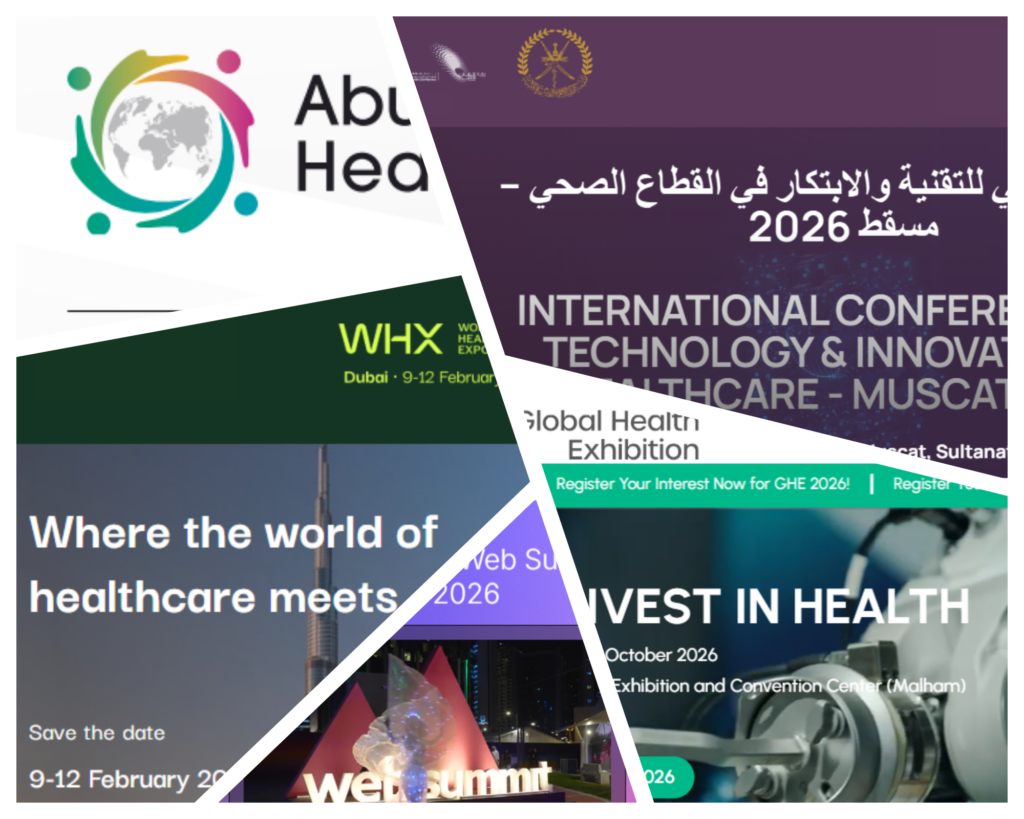
In Dubai, World Health Expo (WHX) Dubai (formerly Arab Health) positions the UAE as a global stage for healthcare technology, clinical innovation and commercial scale. In Abu Dhabi, Abu Dhabi Global Health Week 2026 is designed as a convening point for innovators, investors and system leaders. In Saudi Arabia, the Global Health Exhibition in Riyadh reinforces the Kingdom’s ambition to be a hub where healthcare innovation meets investment and implementation. In Qatar, Web Summit Qatar 2026 brings global tech and entrepreneurial ecosystems into the region’s conversation about what comes next.
This matters for hospital leaders because conferences are only the visible outworkings of this strategy. Underneath them are national strategies and multi‑year programs that are explicitly connecting health outcomes to digital infrastructure.
Saudi Arabia's Health Sector Transformation Program explicitly identifies access, quality and digital transformation as core levers. Qatar's Ministry of Public Health outlines a national framework through the Qatar National E-Health & Data Program, focused on EMR adoption and foundational data capabilities. In the UAE, the Ministry of Health and Prevention's strategy emphasizes innovative services grounded in digital data, while Abu Dhabi's Department of Health has been publicly articulating a shift toward an intelligence-driven health system, including through its recent collaboration with the World Economic Forum in A New Era for Digital Health.
Even so, Oman’s story deserves to be told on its own terms. Its approach to healthcare transformation is firmly anchored in Oman Vision 2040, which positions health as a national priority tied directly to social well-being, economic sustainability and human capital development.
The vision articulates a strategic direction toward a leading healthcare system aligned with international standards, emphasizing prevention, quality, transparency, accountability and decentralization. It also places a strong emphasis on developing qualified national talent, advancing scientific research and innovation, and enabling technology-driven medical systems that deliver high-quality preventive and clinical care across all levels. Importantly, Vision 2040 frames health not solely as a service, but as a shared societal responsibility, supported by sustainable financing and governance structures designed for long-term resilience.
The hospitality experienced in Muscat extended far beyond generosity. It reflected pride, care and an openness to collaboration, deeply rooted in Omani culture. The discussions were thoughtful. The pace was intentional. The focus was on building systems that serve communities for decades, not quarters.
Many clinicians and leaders across the GCC train in the United States and return home with deep respect for American clinical rigor. At the same time, they often see our digital fragmentation more clearly than we do. The result is not a simple catch-up narrative. It is a different trajectory altogether.
For American health data leaders, there is much to learn here. Regions that can design systems at scale, with governance embedded from the outset, become living laboratories. They generate lessons on interoperability, cyber resilience, workforce development and data stewardship that are globally relevant.
This is why the American College of Health Data Management is leaning in. Our goal is not to generalize the region, but to elevate local voices and connect them to a global community of practice. Oman’s contribution to this conversation is distinct and deserves recognition.
This article is the first dispatch from this arena. In the coming months, we will attend additional GCC convenings and report back — not as tourists of innovation, but as data stewardship practitioners, watching how strategy becomes execution. If you are a health data leader in the U.S., consider this your nudge – pay attention to the Gulf’s healthcare transformation, not because it is “international,” but because it is increasingly central to where the next playbooks are being written.
Dr. Julia Rehman, DHA, FACHE, FACHDM, is an Executive Fellow and Mitchell Josephson, MBA, FACHDM, is president of the American College of Health Data Management.