Doing the Math on a Legend: 18,666 Days, Zero Wasted Words
Some editors chase headlines. Fred Bazzoli chased the truth, the correct spelling, and, occasionally, a runaway water bottle in the middle of the London Marathon.
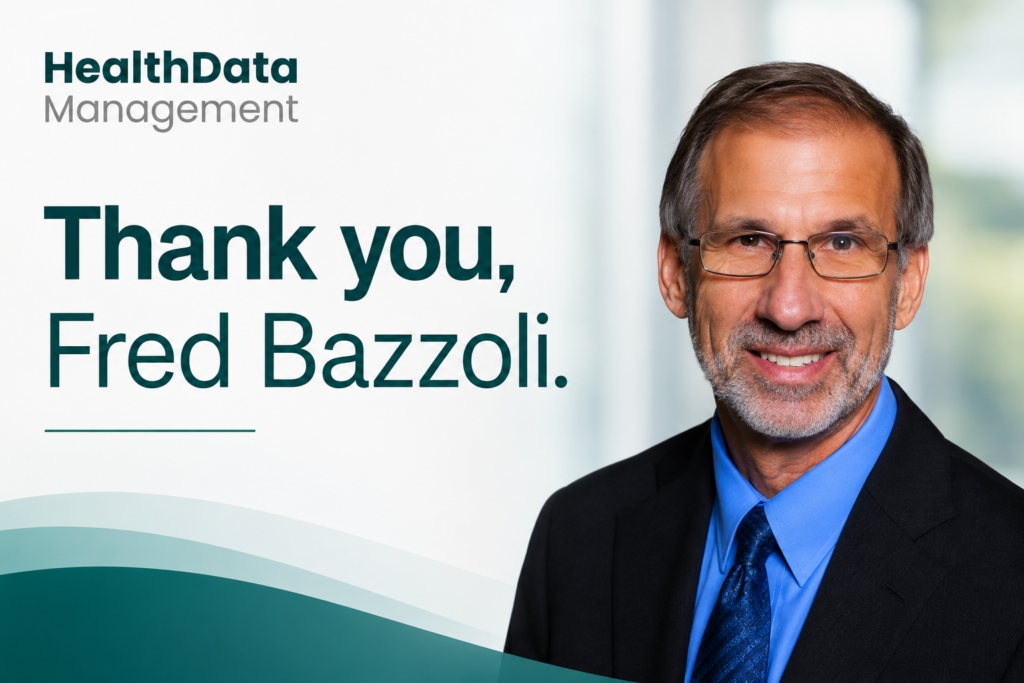
I've spent most of my career reading Fred Bazzoli before I ever had the chance to publish him. That's a strange sentence to write now that Health Sciences South Carolina, the organization I serve, owns the publication he has spent decades building, rebuilding, and, by his own account, nearly finishing a marathon for. So forgive me if this tribute reads a little differently than most retirement send-offs. It's not written by a colleague down the hall. It's written by someone who has been in his readership for most of his career, and who now finds himself, improbably, one of the stewards of the institution he leaves behind.
Fred counted his own career in days: 18,666 of them, from a three-line phone and a Royal typewriter in Mendota, Illinois, to the editor emeritus chair he now inherits at Health Data Management. I'd like to try a different kind of counting. Somewhere north of 5,000 bylines. Three decades of covering the same industry through HITECH incentives, meaningful use, EHR mandates, interoperability rules, TEFCA, and, most recently, what he memorably called healthcare's "Prometheus moment" with artificial intelligence, an essay that opened not with a whitepaper's dry throat-clearing but with the line that AI had become "the Hype Cycle meets Fright Night." That's a sentence only someone with 42 years of watching healthcare technology promise the moon, and occasionally deliver a fax machine, could write with a straight face and a knowing smirk.
Every industry has its chroniclers. Few have one who reviewed literally every article published under his own masthead, the way Fred did in his "Best of" retrospectives, quantifying which topics mattered most to executives before telling them what to read next. That is not the work of someone doing a job. That is the work of someone who had, by his own definition, turned a profession into a passion. It shows in the small, telling details he never let go unexamined: the difference between data that's "high-integrity" for a clinician's chart and "terrible" for a researcher using the same record, or his blunt assessment that healthcare's security architecture has been "the same levels of security systems as we did 20 to 30 years ago, and we just keep piling more on top of them." Only a journalist who has genuinely sat with hundreds of CIOs, CISOs, and vendors could distill that much frustration into one perfectly quotable sentence, and then go find someone else to blame besides the reporter.
I have to imagine that editor in Mendota (the one who marched Fred through the dictionary over "catagory," 30 feet and one furious phone call away) would be delighted to know that his lesson stuck for 18,666 days and counting. Fred spent the rest of his career doing to vendor press releases and hype cycles exactly what was done to him: demanding they get the spelling, the substance, and the source right before they got anywhere near print. Somewhere, a generation of PR professionals who tried to sneak "revolutionary" and "game-changing" past his editing pencil owe that irritable Mendota editor a debt of gratitude they will never know they have.
What strikes me most, having caught up on years of his columns in preparing this tribute, is how consistently Fred wrote about perseverance without ever making it sound like a lecture. His account of collapsing on a discarded water bottle at mile eight of the London Marathon, being lifted up by six strangers he called his "angels," and half-walking, half-willing himself through 18 more miles to finish in 57,000th place out of 60,000 (dead last by most measures, and yet somehow the most triumphant finish described in Health Data Management all year) reads less like a running column and more like a mission statement he'd been living out since 1975. "A consequential life," he wrote, "is one that commits to doing hard things." He was not, it turns out, only describing marathons. He was quietly describing four decades of daily deadlines, industry pivots, a magazine that got shuttered and had to be revived as a nonprofit, and a healthcare IT press corps that has watched entire companies, and occasionally entire publications, disappear underneath them.
That revival is the part of the story I know best, because it's the part I now own. When Health Data Management came back from its 2020 shutdown as a nonprofit publication under our HSSC umbrella, Fred didn't just agree to keep writing. He agreed to rebuild the thing, article by article, and to make sure the resurrected version stood for something more durable than a news cycle: analysis over churn, trust over traffic. Every reporter he trained, every "Editor's View" column he filed on interoperability, every roundtable he moderated on terminology standards was another brick in a publication that our organization is now honored, and admittedly a little intimidated, to be entrusted with.
So, Fred: on behalf of an industry that has quoted you more than it has probably ever told you, and on behalf of an organization that now gets to carry your publication forward, thank you. You leave behind more than 18,666 days of bylines. You leave behind the standard the rest of us are now expected to meet: for accuracy, for integrity, for asking one more question of the CIO everyone else stopped questioning. Wear the vest proudly. Keep writing when the mood strikes. And should you ever need someone to double-check the spelling of "category," you already know we'll answer the phone.
Kenneth R. Deans, Jr., DHA, MBA is President and CEO of Health Sciences South Carolina, parent organization of HDMGroup and Health Data Management.