Digital health must enable communities to care for themselves
A digital health platform is often built for one scenario and dropped into another with no common threads. That doesn’t provide sufficient granularity.
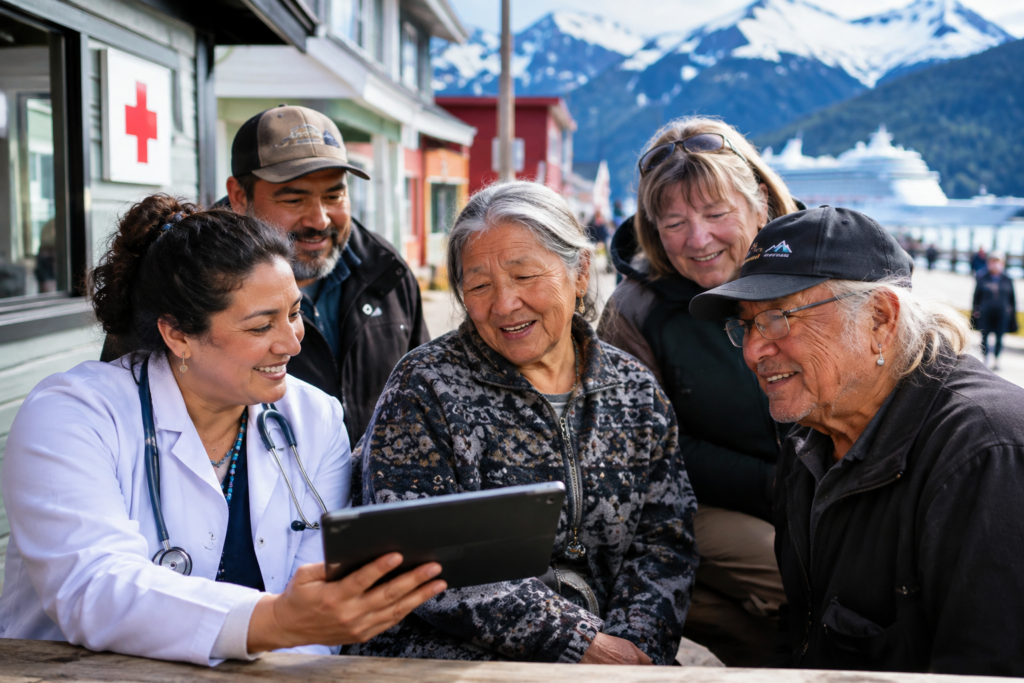
When I think about how digital healthcare can improve, Skagway, Alaska comes to mind.
The town has about 1,200 year-round residents but gets more than a million visitors annually from cruise ships. On summer days, as many as 8,000 tourists crowd one street, but in the winter, locals have to adapt to massively slowed business.
They came up with a solution, which involves rotating resources. Certain restaurants close for several weeks, and staff work the ones that stay open. Everyone shares the burden, everyone shares the opportunity, and restaurants navigate the annual trough. No app designed this, and no dashboard optimized it from thousands of miles away. Skagway residents, who understand their own stakes, built a successful and durable system for themselves.
Digital health needs to take a cue from Skagway. Communities know how to care for themselves, and the industry’s most valuable role is to bolster them in doing so.
Solutions designed far from community often fail
Community is not just geography; it’s culture, language, faith and family structure, the texture of how people live with each other. A digital health platform is often built for one scenario and dropped into another with no common threads.
But community healthcare needs are specific and local in a way that resists standardized solutions. Platforms quickly prove to be ineffective, inefficient and expensive, with low adoption rates overall because people in the community know better.
Most healthcare technology is built by people who do not live in the communities it serves and then directs them on how to solve problems from afar. We should, instead, hand communities the collaboration tools to solve their own problems.
A review of evidence shows that communities that help shape their own health services see better health outcomes. A review of digital health platforms for chronic disease management found benefits for patients and providers, with researchers pointing to co-design as a way to build on that progress.
A dashboard that tells a rural physician what leadership wants measured, but it does not tell them what is happening with a patient in the emergency department 50 miles away. That doesn’t help the patient. What does help is a solution they can run with that works with any medium, including the still ubiquitous fax and phone.
Solutions built by communities, enabled by technology (in many cases, free to clinical and non-clinical providers alike), tend to make ultimate fixes cheaper and more effective for everyone, not only more equitable.
Changing who designs the delivery
A federal model shows what changes when the people closest to the problem have design authority. Federally Qualified Health Centers, which are a primary gateway for most health access and care in rural locations, are required to have governing boards made up of at least 51 percent patients of the health center.
Those boards have authority over key decisions, including services and service schedules, while the centers must also meet Health Resources and Services Administration requirements for access, sliding-fee discounts, and quality improvement.
The science and the clinical goals stay the same, but what differs is who has final say over what care looks like on the ground. FQHCs now serve more than 32 million people and are widely recognized as an important, cost-conscious primary-care model for underserved populations. Research has linked health center care with lower spending and fewer avoidable emergency department visits in some Medicare and Medicaid populations. Patients are more likely to stick with interventions designed to fit their daily lives.
On-the-ground program design and decision-making are what move outcomes. Technology should support this, not circumvent it.
Arming communities, not strong-arming communities
Technology couldn’t solve the problem for Skagway, and no one designed this fix from the outside; only the community could, as it intimately knew its ebbs and flows and shared living structures. They needed the conditions under which their own solution would work.
Digital health's role is the same. Build a shared infrastructure for communities to solve their problems for themselves, with community taking care of community. It’s about putting the right information in front of the right person at the right time and then getting out of the way. Only then can real population-level progress happen from the ground up.
Monica Rivera is the chief growth officer at Watershed Health and has more than 20 years of experience in growth, strategy and partnerships across payer, provider and community care settings and the communities they serve.