AI that once angered radiologists is now their hope for work relief
Despite early predictions that AI would supplant image professionals, the technology is being put in roles to reduce burnout risks.
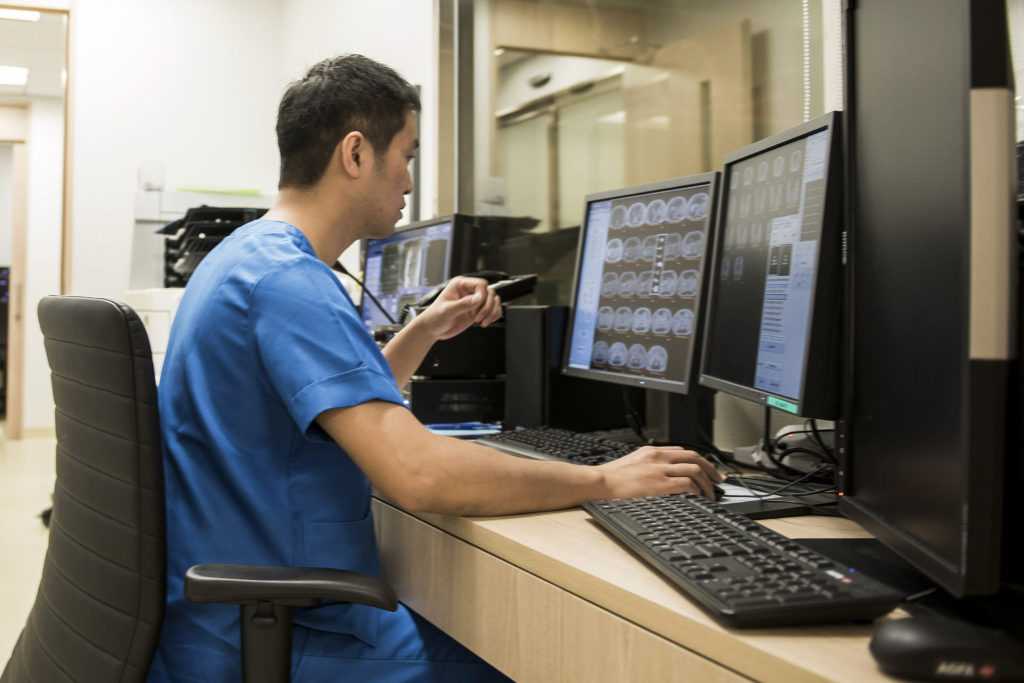
As radiologists deal with intensifying work pressures, they’re now counting on the capabilities of artificial intelligence to help lessen the load.
Workloads have increased dramatically for radiologists, as more imaging studies are being ordered for patients, with more images being taken per study and with radiologists taking on more responsibility for catching abnormalities.
All that comes while there is a shortage of radiologists, creating a growing imbalance. Imaging volumes are projected to rise by 3 percent to 4 percent annually, while workforce growth remains limited due to retirements and training bottlenecks. Workloads are causing concern over clinicians’ capabilities to do the work and heightened risks of burnout.
Multiple presentations and product developments at the annual meeting of the Radiological Society of North America (RSNA) demonstrated increasing application of AI to help radiologists by easing their loads through better workflow support, predictive capabilities and diagnostic support.
Reversing history
AI wasn’t always seen as a savior for radiologists. It was perceived as serious competition; in 2016, article in The New England Journal of Medicine predicted that “machine learning will displace much of the work of radiologists and anatomical pathologists.” That set off panic two months later at the RSNA conference, creating a negative perception of artificial intelligence at the outset.
Even up to a couple years ago, much work remains to successfully incorporate AI in radiology, said presenters at an RSNA session.
But the article resulted in reduced numbers of those going into radiology, says Raj Chopra, MD, chief medical officer at Merge and a practicing radiologist for 20 years. “The article had a huge influence on those who wanted to go into radiology,” he says. Nearly a decade later, there’s a radiologist shortage, even as imaging volumes have increased.
The NEJM article reflected the hope that AI would be able to screen imaging exams faster, more effectively and with greater precision than radiologists, but that hasn’t materialized. So called “pixel AI” really hasn’t delivered on that promise, Chopra says. Now, the immediate hope is for using AI to increase efficiency.
“There are reporting tools that are out there that are showing a benefit in efficiency,” he says. “We’re excited about those because there’s actually a (return on investment).”
Even incremental gains in efficiency are important because radiologists are having trouble keeping up with the lists of exams they must work through each day. “A few years ago, we used to be able to finish our lists. Now, in the outpatient world, we can’t. And the fear is that there are things sitting on that list that are time bombs for patients. AI can help us prioritize studies, and it provides triage capabilities.”
Wholistic solutions
RSNA’s exhibit floor showed technology advances that promise to use AI more broadly across the entire workflow. That differs from the early applications of the advanced technology, which typically had been focused on discrete use cases that often did not fit neatly into radiologists’ workflows.
That broader approach to using AI is intended to bring increased efficiency to manage workloads. Chopra of Merge recalls a recent day where he viewed about 210 imaging studies. That type of workload is difficult to sustain, but he says that if AI can make him 15 percent more efficient, it can make a huge difference in being able to keep up and maintain quality.
AI can bring both efficiency and relief, says Sham Sokka, chief operating and technology officer for digital health at RadNet. He notes there are different technology stacks that providers must manage, such as picture archiving and communication systems (PACS), radiology information systems, reports systems and more.
Two years ago, Los Angeles-based RadNet, which provides outpatient diagnostic imaging services, announced the launch of DeepHealth, a product line it designed to use AI to “drive efficiency and transform radiology’s role in healthcare.”
Sokka says DeepHealth is designing tools to support “people in the (radiology) workflow. We’re not just bringing solutions from a technology company perspective. There’s an urgent need to navigate clinical, financial and operational challenges. The systems we have now result in disconnected patient engagement, a strained workforce and inconsistent clinical outcomes.” At RSNA, DeepHealth announced suites that aid diagnostics and operations, as well as disease-specific applications.
Using an integrated solution such as DeepHealth’s is important because radiologists “want to be more efficient, but we’re not going to sacrifice quality,” says Jason Sinner, MD, a diagnostic radiologist based in California. “With reporting speeds and (system) consistency, there can be an increase in reporting productivity, and then we can focus on the actual findings of the (imaging) study.”
Newer companies are also incorporating AI at the start of technology development. For example, Raidium, based in Paris, has developed an AI-native PACS viewer that is intended to reduce fragmentation by enabling the use of AI and interactive voice technology similar to ChatGPT, says Paul Herent, a radiologist who co-founded the company.
The interactive chat capability gives clinicians more flexibility in working with imaging studies, he says. Raidium is currently working with research hospitals implementing its Raidium Viewer, and it hopes to receive clearance from the Food and Drug Administration for wider use of its technologies in the U.S.
Raidium, RadNet and other technology developers also are building in AI components that, they say, hold the promise of providing better population health and analytics, which portend downstream benefits for patient care and further savings from their use. While not exactly “pixel AI” in all cases, such benefits could further gain support from radiologists and the health systems that depend on them.